




GOAT LED or Lumatek – Which LED Grow Light Should You Choose?
11/09/2026 00:04:36 Lighting for plants
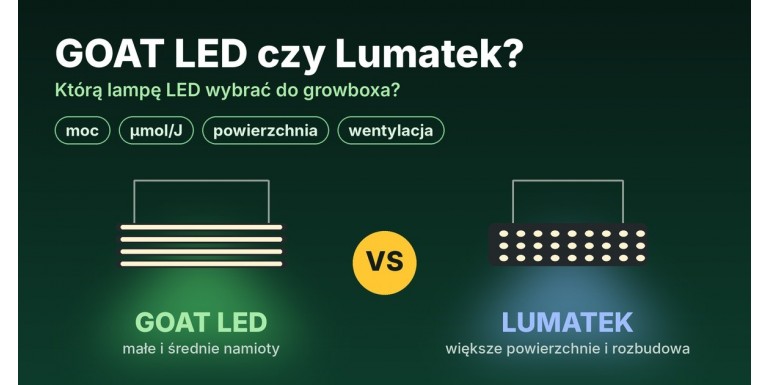
Choosing between GOAT LED and Lumatek should not be based solely on the wattage stated in the product name. When growing plants under lights, coverage area, even light distribution, energy efficiency, dimming options and matching the equipment to conditions in a grow tent or other growing space also matter. Both brands offer LED grow lights intended for home plant cultivation, but they may suit slightly different needs and budgets. Below, we explain when GOAT LED may be worth considering and when Lumatek may be the better fit.
GOAT LED or Lumatek – the short answer
If you are looking for a practical LED grow light for a small or medium-sized growing space and want to use your budget wisely, it is worth starting with the GOAT LED range. This group includes designs suited to popular grow tents and supplemental lighting for houseplants.
Lumatek is a natural direction for growers looking at a more advanced lighting segment, wanting to expand their system or planning intensive use over a larger area. You can compare current models in the Lumatek LED grow lights category. That does not mean every Lumatek light is automatically better than every GOAT LED model. The key is to compare specific units in the same power class and for the same coverage area.
First, define your plants’ needs and the size of your growing area
One of the most common mistakes when buying a grow light is choosing one “for future-proofing” without considering the dimensions of the grow area. A light that is too small may not adequately cover the edges, while an overly powerful unit used in a small grow tent may require very careful adjustment of its height and output, as well as efficient air exchange.
Before buying, measure the actual area where your plants stand. Also account for the space taken up by the filter, fan, cables and the light itself. In small tents, a compact format and adjustable light output are usually important. In wider spaces, even light distribution across the whole area becomes more important, which is why bar-style fixtures are popular.
A good starting point is to browse the LED grow lights for plants category and filter products according to their intended use. If you are setting up a compact space, it can also help to compare lights in the 100W–300W LED grow lights for plants section. For larger tents, units from the 300W–600W LED grow lights for plants range are more often suitable.
What should you compare in GOAT LED and Lumatek lights?
The brand matters, but it cannot replace an assessment of the specifications of a particular model. On product pages, pay attention to several aspects that directly affect ease of use and plant-lighting performance.
1. Actual power draw and coverage area
A light’s name, marketing comparison wattage or number of diodes do not tell the full story. Check the manufacturer’s declared power consumption and recommended growing area. Then compare this information with the size of your grow tent and your plants’ stage of development.
A light selected for an area that is too large may need to run at high output throughout the entire cycle. On the other hand, a unit that is too powerful for a small tent does not have to be a poor choice, provided it offers smooth or stepped dimming and you maintain the appropriate distance from the plants. Power adjustment gives you flexibility for different growth stages, but it does not remove the need to observe how the leaves respond.
2. Light efficiency and light quality
LED light descriptions may include a value expressed in µmol/J. This refers to the fixture’s photon efficacy, meaning how efficiently it converts the power it draws into light useful to plants. A higher value can be beneficial, but it should be considered alongside the overall light design, coverage area and build quality.
It is not worth relying on the term “full spectrum” alone. In practice, it matters whether the manufacturer clearly presents the lighting characteristics, intended use and recommendations for the fixture. For most home grows, a versatile LED light that allows plants to be grown through subsequent development stages without replacing the fixture is a convenient solution.
3. Design: panel or bar light?
Narrower panels can be convenient for small growing areas, shelves and compact tents. Bar-style designs, made up of several parallel bars, often make it easier to provide even coverage across a larger rectangle. However, a light should not be judged by its shape alone: diode spacing, hanging height and control options also affect the result.
An example of a bar light in the GOAT range is the GOAT LED 320W Full Spectrum BAR. This format is worth considering primarily if you want broader coverage and find it easier to maintain similar lighting conditions for plants placed in different parts of the tent.
4. Control, dimming and future expansion
It is worth checking whether the chosen model has a power control, what external control options are available, and whether those functions are genuinely needed for your grow. For a beginner, a simple dimmer may be more useful than an extensive system that will not be used.
However, if you plan to expand your growing area over time or automate several devices, higher-end models may offer more integration options. For larger spaces, one example worth checking is the LUMATEK ZEUS 600W LED 2.6 µmol Plant Grow Light. Before purchasing, always compare the current specifications, installation requirements and the manufacturer’s recommended coverage area.
GOAT LED – who is it a good choice for?
GOAT LED is worth considering when you are building your first setup or upgrading older lighting and expect a practical solution for a specific area. The range may appeal to people who want to match a light to a small or medium grow tent without immediately moving into the most advanced configurations.
- for people putting together a basic or intermediate growing setup,
- for small and medium grow tents, once the model is matched to the dimensions,
- for users who value power adjustment when it is available in the chosen model,
- for those who prefer to allocate part of their budget to ventilation, growing medium and plant care as well.
For example, the GOAT LED EVO 150W 2.9 µmol PRO may be worth comparing if you are looking for a compact LED grow light. The final decision should be based on the manufacturer’s current information, the dimensions of the illuminated area and the needs of the specific plants.
Lumatek – when is it worth paying more?
Lumatek is widely associated with a more professional segment of plant lighting. It is worth taking a closer look if you plan to use the light regularly, need to cover a larger area or want features useful in a more extensive system.
The brand’s range includes both lights for standard grow tents and more powerful designs for larger growing spaces. One example is the Lumatek Apollo 2.8 µmol/J 550W LED grow light for 120 × 120 cm, described as intended for a 120 × 120 cm area. This type of declaration is particularly valuable when comparing equipment because it allows you to match the manufacturer’s recommendation with the actual size of your own grow tent.
Paying more for a higher-segment light makes sense when you will use the specific features it provides: a better fit for a large area, more convenient control, more efficient operation or a design suited to intensive use. If you do not need those capabilities, a properly selected GOAT LED may be the more sensible purchase.
Do not ignore temperature and ventilation
Even an efficient LED grow light releases some energy as heat. In an enclosed grow tent, temperature and humidity can change quickly, especially when the unit operates for long periods or close to the plants. That is why you should plan the lighting purchase together with airflow.
Match the fan, filtration and ducting to the tent’s volume and the resistance of the installation. The ventilation for growing plants range can help you select the elements needed to stabilise conditions. Monitor temperature at plant canopy height, not only near the tent floor. If necessary, increase air exchange, raise the light or reduce its output according to the manufacturer’s instructions.
Light is important, but it is not the whole growing system
Even the best light cannot replace correct watering, a suitable growing medium, a stable climate and sensible fertilisation. Plants respond to the full set of conditions, so it is worth introducing changes one at a time and observing the results. This makes it easier to identify whether an issue comes from lighting, temperature, humidity or nutrition.
For growing in organic media, many users choose ready-made fertiliser sets. The guide to choosing fertilisers for home growing may be useful, but use should always be adapted to the plant’s development stage and the manufacturer’s recommendations. Fertilisation should not be used to compensate for unsuitable lighting—stabilise the basic growing conditions first.
GOAT LED or Lumatek: a practical buying decision
The best light is not the one with the highest number in its name, but the one that suits your space, goal and budget. Before placing an order, answer a few questions:
- What are the exact dimensions of the area to be illuminated?
- Will the light operate in a grow tent, on a shelf or in a greenhouse?
- Do you need power adjustment and external control?
- Can the ventilation handle the heat generated in an enclosed space?
- Do you plan to expand your grow in the future?
- How much do you want to spend on the whole system, rather than the light alone?
GOAT LED can be the right choice if you are looking for a sensibly matched light for a particular area and value functionality. Lumatek is worth considering if you expect a more advanced design, work over a larger area or plan to expand the installation. In both cases, comparing current product pages matters more than comparing logos alone.
FAQ – GOAT LED and Lumatek
Is Lumatek always better than GOAT LED?
No. It depends on the models being compared, the size of the grow and the user’s needs. Lumatek may offer higher-segment solutions, but a well-selected GOAT LED light may be better suited to a small or medium setup and the available budget.
What LED grow light wattage is right for a grow tent?
There is no single wattage that can be recommended without knowing the tent dimensions, plant type and stage of cultivation. Follow the manufacturer’s recommended coverage area, actual power draw and dimming capability. Compare models intended for similar coverage areas.
Does an LED grow light need a dimmer?
It is not essential, but power adjustment is very practical. It makes it easier to adapt light intensity to young plants, temperature conditions and the available height in the grow tent.
Does LED lighting require ventilation in a grow tent?
Yes. LED lights are usually more energy-efficient than older lighting technologies, but they still emit heat. In an enclosed tent, proper air exchange helps maintain more stable temperature and humidity.
What should you look at beyond the light brand?
Check the actual power draw, stated coverage area, design type, dimming options, installation requirements and warranty terms. The dimensions of the grow tent and ventilation capacity are equally important.