

Are LED Grow Lights with UV and IR Better? Facts and Myths
11/24/2026 00:04:17 Lighting for plants
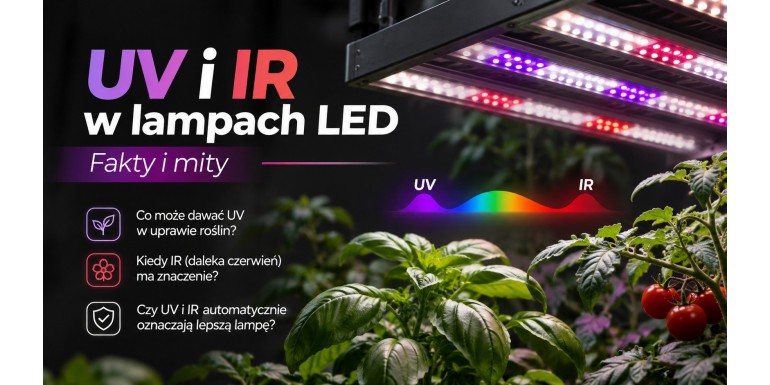
LED grow lights with additional UV and IR diodes attract considerable interest among indoor growers. They are often presented as a more “complete” solution than standard full-spectrum fixtures. But does the presence of UV and IR automatically make a light better? Not always. Lighting quality is determined primarily by matching the fixture to the growing area, its actual power draw, even coverage and the ability to control conditions in the grow tent. Additional light ranges can be a valuable complement, but it is worth understanding their role without marketing shortcuts.
UV and IR in an LED grow light – what do they mean?
UV refers to ultraviolet radiation, meaning wavelengths shorter than visible light. In plant growing, this usually means UVA, which is closest to the violet part of the spectrum. UVB is more energetic and requires particular caution, both for plants and for anyone near the light source.
IR, in turn, means infrared. In descriptions of grow lights, this term may refer to far-red light, usually close to the boundary of visible light, or to thermal radiation. The distinction matters: far-red can influence plant photomorphogenic responses, whereas infrared perceived mainly as heat primarily changes leaf and surrounding temperatures.
In practice, it is worth reading a product description more closely than simply looking at the “UV + IR” label. The manufacturer should clearly state which additional diodes are used and what role they are intended to play within the overall spectrum.
The key fact: full spectrum does not need separate UV and IR diodes
A good LED grow light does not become effective only after UV and IR are added. The foundation is a properly designed spectrum within the range plants use for photosynthesis, along with sufficient light intensity across the growing area. Without this, additional diodes will not solve the problem of an underpowered light or poor illumination in the corners.
Modern full-spectrum designs are usually based on white diodes, often supported by red light. This solution can work well at different stages of plant development. If you are considering your basic options, the LED grow lights for plants category is a useful starting point for comparing fixtures by intended area and application.
What matters more than the “UV + IR” label?
- matching the light to the dimensions of the tent or growing shelf,
- actual power draw and fixture efficiency,
- even light distribution,
- the ability to adjust output and hanging height,
- heat dissipation and ventilation conditions,
- build quality and transparent manufacturer information.
In a small space, the ability to reduce power is equally important. A light operating too close to plants or at excessive intensity can cause light stress, even if it offers a highly expanded spectrum.
What can UV do in plant growing?
A moderate share of UVA can trigger specific defensive and developmental responses in plants. Some species respond to this stimulus with changes in the production of protective compounds or pigments. However, the effect depends on the species, cultivar, intensity, exposure time, growth stage and other environmental conditions.
This is exactly why UV should not be treated as a universal “quality booster”. For one plant and under a particular growing strategy, it may be a justified addition, while in another case it may bring no visible benefit or prove to be an excessive stimulus.
Myth: more UV always means a better result
This is a myth. UV light does not work on an “the more, the better” basis. Exposure that is too intense or too long can stress plants and lead to damage. Particular care is needed with additional UV sources used without the ability to control operating time and without knowing their parameters.
If a light has UV diodes built in at the factory, they are usually part of its designed spectrum. Even so, you should observe your plants, keep the manufacturer’s recommended distance and not assume that every crop needs the maximum possible dose of light.
Far-red and IR – when can they matter?
Far-red is connected with natural mechanisms through which a plant receives signals about its surroundings and competition for light. It can affect, among other things, plant form and responses related to light and dark cycles. However, this does not mean that adding it will be beneficial in every situation.
For some species or in limited spaces, too much emphasis on far-red can encourage excessive shoot stretching. Therefore, in home growing, where a compact plant and easy height control are important, the balance of the entire spectrum and proper plant training remain crucial.
It is also worth remembering that traditional light sources can give off more heat than LEDs. If you are comparing technologies, see HPS lamps as a reference point for light characteristics and temperature management rather than as an automatic LED replacement.
Myth: IR speeds up growth with no trade-offs
This is an oversimplification. Additional far-red can change the way a plant responds to light, but the outcome depends on spectral proportions and the entire environment. Without controlling temperature, humidity, watering and the distance between the lamp and plants, it is not worth expecting a predictable effect solely because IR diodes are present.
Facts and myths about LED grow lights with UV and IR
Fact: additional ranges can be useful
Yes, but as part of a coherently designed fixture. UV and far-red can complement a spectrum, especially when the manufacturer has deliberately included them and the user can adjust light output and hanging height to the plant development stage.
Myth: a light without UV and IR is not suitable for demanding growing
False. Many effective LED fixtures are based on a well-selected full spectrum without highlighting separate UV or IR channels. Growing success is more often determined by the fundamentals: the right amount of light, a stable climate and regular plant observation.
Myth: purple light means strong UV is present
The colour of emitted light visible to the eye does not allow you to reliably assess the UV share. Purple can come from diodes operating in the visible part of the spectrum. Reliable information should be sought in the specification and documentation for a particular model, not in the colour of its glow alone.
Fact: working comfort around the light matters
Grow lighting, especially when intense, can tire the eyes. When checking plants with the fixture switched on, it is worth protecting your eyes and avoiding looking directly at the diodes. LED and HPS grow-light glasses can be practical equipment when matched to working conditions and used as intended.
How to choose an LED grow light with UV and IR sensibly
Start with the area. Compact fixtures with power matched to the growing surface are usually chosen for small grow tents, rather than the largest available model. In this group, it is worth comparing 100W–300W LED grow lights, paying attention to stated coverage, dimming capability and diode layout.
For a larger area, not only higher power but also the distribution of light points matters. Bar-style fixtures or expanded panels can spread light more effectively than a single concentrated source. It is therefore worth analysing solutions in the 300W–600W LED grow lights category, always relating your choice to the actual dimensions of the growing area.
An example of a light whose description indicates the presence of additional UV is the LEDMAX PRO 300W + UV LED grow light. Such a model should be assessed as a whole: in terms of area, power adjustment, heat requirements and whether its characteristics suit the planned grow. The “+ UV” label alone should not be the only buying criterion.
A short list of questions before buying
- What is the exact growing area and available height above the plants?
- Does the light have output control useful at different development stages?
- Does the manufacturer provide clear information about the spectrum and how to use the fixture?
- Can the ventilation handle the heat generated by the light?
- Do I need UV/IR, or would better light uniformity matter more?
Light is not everything: growing conditions must work together
Even the best-matched spectrum will not compensate for mistakes in watering, fertilisation, temperature or air circulation. Plants under stronger lighting may take up water and nutrients at a different rate, so changes to lighting should be introduced gradually.
For comprehensive plant care in indoor growing, you can consider BIOBIZZ Trypack Indoor fertilisers. Fertilisers should always be used according to the manufacturer’s recommendations, plant observations and a dose adjusted to their current condition. Light, hydration and nutrition form one system – improving only one element rarely delivers the full effect.
FAQ: LED grow lights with UV and IR
Is it worth buying an LED grow light with UV and IR?
It can be worthwhile if the additional diodes are part of a well-described design matched to the grow. However, UV and IR should not be considered more important than power, even light distribution and the ability to adjust the fixture.
Is UV safe for plants and the user?
Safety depends on the type of UV, its intensity and exposure time. The manufacturer’s recommendations must not be ignored. When working around intense light, protect your eyes, do not look directly at the diodes and limit unnecessary exposure.
Do lights with IR raise the temperature significantly?
It depends on the fixture design and what the IR abbreviation means in its description. Far-red is not the same as strong thermal radiation. Every light consumes energy and releases some of it as heat, so good ventilation remains necessary.
Is a separate UV light better than UV diodes in an LED panel?
There is no single answer. Built-in diodes can be convenient because they are part of the factory-designed spectrum. A separate source potentially provides more control, but requires knowledge, caution and the ability to set its operating time precisely.
What should you look for in your first grow-tent light?
First, match the fixture to the dimensions of the grow and ensure that its power can be adjusted. Treat additional UV or IR as an advantage only after checking the basic parameters and the conditions you can provide for your plants.
Summary
LED grow lights with UV and IR are not inherently better than all other fixtures. They can offer an interesting spectrum complement, but their usefulness depends on the light’s design, the type of grow and skilful management of conditions. The most sensible purchase decision starts with area, power, even light distribution and adjustability. Only then is it worth comparing the presence of additional UV and far-red diodes. This approach helps you choose lighting that is effective, safe and suited to the real needs of your plants.