




150W, 240W or 300W LED Grow Light – How to Choose the Right Wattage?
11/14/2026 00:04:08 Lighting for plants
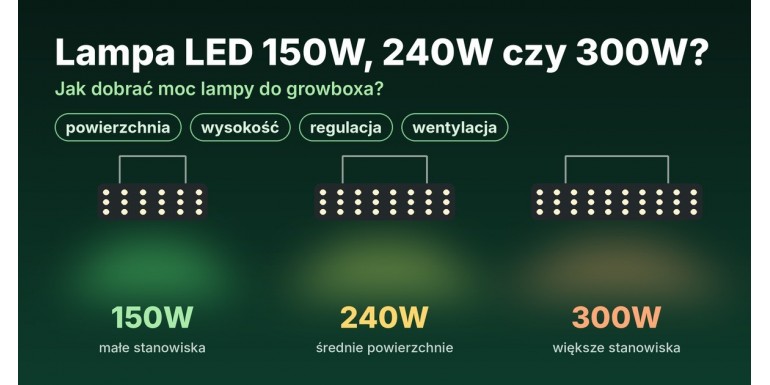
Choosing between a 150W, 240W and 300W LED grow light should not begin with the question, “are more watts always better?”. For home indoor growing, the key factor is matching the light to the area occupied by plants, the fixture design, efficiency, dimming capability and conditions inside the grow tent. Insufficient light can limit growth rate, while an overly powerful lamp used without proper control can make it harder to maintain the right distance, temperature and even light coverage.
Why wattage alone is not enough
Watts (W) describe the electrical power consumed by a lamp. This is important when estimating electricity costs and planning the electrical installation, but it does not directly tell you how much plant-useful light reaches the growing area. Two fixtures with the same wattage may differ in LEDs, driver, panel layout, optics and light efficiency.
When comparing LED grow lights, consider several factors at once:
- actual power draw stated by the manufacturer,
- recommended coverage area for the relevant growth stage,
- photon efficacy, if provided by the manufacturer,
- light uniformity at the edges and centre of the grow area,
- dimming capability, which makes it easier to adjust the lamp to the stage of development,
- mounting height and the amount of free space above the plants.
Instead of relying only on the wattage figure, browse our selection of LED grow lights for plants and always check the description of the specific model. A manufacturer may recommend one coverage area for vegetative growth and another for more intensive lighting of plants with higher requirements.
Measure the area you want to light first
The most important starting point is the active growing area, rather than only the external dimensions of the tent. If part of the grow tent is taken up by a humidifier, fan or cables, or if plants occupy only part of the floor, the illuminated zone may be smaller.
For example, an area of 60 × 60 cm equals 0.36 m², 80 × 80 cm equals 0.64 m², and 100 × 100 cm is a full 1 m². The difference may seem small, but in practice it translates into clearly different lighting requirements and intensity distribution.
Typical uses for 150W, 240W and 300W lights
| LED grow light wattage | Most common use | What to consider |
|---|---|---|
| 150W | Small growing areas, usually around 60 × 60 cm; depending on the design, also other small spaces. | Check coverage in the specification and the distance from plant tops. |
| 240W | Medium-sized areas and grows that need stronger, more even supplementary lighting. | Fixture dimensions, tent height and ventilation capacity matter. |
| 300W | Larger growing areas, often close to 100 × 100 cm if the manufacturer specifies this coverage. | Power adjustment, light distribution and climate control are important. |
These are deliberately broad guidelines. Not every 150W lamp will cover the same area, just as not every 300W fixture will provide identical coverage. For example, the LEDMAX ECO 150W LED grow light is specified for a maximum area of 80 × 80 cm, while the COSMOS 300W LED lamp is intended by the manufacturer for a larger tent. Such information is more useful than simply converting wattage figures.
150W LED grow light – when is it a good choice?
A 150W LED grow light is a sensible option for growers working in a small area, especially when they want a compact setup and lower energy use. It also works well as lighting for young plants, herbs, seedlings and ornamental plants grown in a small tent or dedicated space.
For small grow tents, it is worth choosing a fixture that not only has suitable wattage but also distributes light more broadly than a highly concentrated design. This helps limit situations where the centre of the area is strongly lit while the corners remain noticeably weaker.
If you need intensity control, consider dimmable models such as the Grow The Jungle The Jackson 150W dimmable LED grow light. The COSMOS 150W LED lamp is another fixture in this power range. Before purchasing, however, compare more than wattage: also consider installation requirements, coverage area and the manufacturer’s guidance on positioning the lamp above plants.
Limitations of 150W
One 150W light may not be the best solution when you want to evenly illuminate a full 100 × 100 cm area or a very densely planted space. Raising the fixture helps broaden the coverage, but it also reduces the light intensity reaching the plants. In that case, it may be better to consider a more powerful fixture, two separate light sources or a different growing layout.
When should you choose a 240W LED grow light?
A 240W LED grow light is a practical middle ground between a compact 150W fixture and a 300W solution. It is a good direction for growers increasing their growing area or looking for more available light without moving straight to higher energy consumption and heat load.
In this class, the shape of the lamp is particularly important. A larger panel can distribute light more effectively across a rectangular or square area than a small fixture with the same wattage. Dimming is also useful because it lets you begin at a lower power setting and increase it as plants develop and their tolerance to light intensity increases.
An example of a lamp in this segment is the Pure LED Q240 v2 240W grow light. Its selection should be based on the dimensions of the actual growing zone, not on the assumption that 240W automatically suits every medium-sized grow tent.
300W LED grow light – for which area and conditions?
A 300W LED fixture is most often chosen when the growing area requires broader coverage or stronger supplementary lighting. Many lamps in this group are designed for areas of around 100 × 100 cm, but this should always be confirmed in the description of the selected product. The wattage is not the only consideration: LED placement and the way the panel covers the corners of the grow area also matter.
Browse 100W–300W LED grow lights for plants to compare different designs within a similar power range. Available fixtures include the Mars Hydro FC-E3000 300W LED grow light, but the final decision should be made after comparing the dimensions of your setup with the manufacturer’s recommendations.
More power also means more responsibility
A more powerful lamp allows you to work with more light, but it does not remove the need to observe plants and control the environment. Ensure efficient air extraction, proper air circulation in the tent and safe cable management. Even energy-efficient LEDs release part of the energy they consume as heat, while the driver and housing need space for cooling.
If the lamp has a dimmer knob or power switch, there is no need to begin at the maximum setting. Increasing intensity gradually is usually easier to control than suddenly exposing plants to much stronger light.
Grow tent height and distance from plants
The same lamp model will work differently in a low tent than in a tall space. The higher you hang the fixture, the wider the area covered by the light, but the lower its intensity will be at plant level. If you place the lamp too low, the centre may receive too much light while the edges are still less well illuminated.
For this reason, the manufacturer’s mounting-height instructions take priority over universal values found online. Adjust the distance in stages while monitoring plant response. Signs that may require correction include curled leaves, discolouration on the highest parts of the plants or excessive stretching of shoots. These symptoms are not always caused by the lamp alone, so temperature, watering, humidity and nutrition must also be considered.
How should lighting be combined with watering and feeding?
Stronger light can increase the pace of processes taking place in the plant, but it does not replace proper care. Changing lamp wattage, distance from plants or lighting time should go hand in hand with regularly observing substrate moisture and leaf condition. Do not increase fertiliser dosage simply because a more powerful lamp is being used.
For plants that require feeding, use products according to the label and take the growing medium into account. For growers looking for a fertiliser set for indoor cultivation, BIOBIZZ Trypack Indoor is the recommended option in this article; always base dosage on the fertiliser manufacturer’s recommendations and the needs of the specific plant.
Common mistakes when choosing an LED grow light
- Choosing a lamp based only on wattage. Efficiency, coverage and fixture design are equally important.
- Ignoring the dimensions of the active growing area. Tent size does not always equal the area occupied by plants.
- Hanging the lamp without allowing for adjustment. Plants grow, and their lighting needs change as they develop.
- Lack of suitable ventilation. Every lamp affects thermal conditions in an enclosed space.
- Using full power from day one. It is safer to adjust intensity gradually and observe the plants.
- Overlooking the manufacturer’s instructions. Coverage and mounting recommendations apply to the specific model.
FAQ – choosing a 150W, 240W or 300W LED grow light
Is a 300W lamp always better than a 150W lamp?
No. A 300W lamp may be the better choice for a larger area, but in a small grow tent its potential can be harder to use. Match the wattage and fixture coverage to the growing area and your ability to control conditions.
What LED grow light fits a 60 × 60 cm grow tent?
Lamps around 150W are often considered, but the right choice depends on the recommended coverage of the specific fixture, its efficiency and the planned growth stage. Check the manufacturer’s data rather than assuming every lamp with this wattage performs identically.
Can a 240W LED grow light be used in a smaller area?
Yes, if the device design and the manufacturer’s recommendations allow it. Power adjustment is particularly useful because it enables you to reduce light intensity. Maintain an appropriate distance from plants and provide adequate ventilation.
How do I set the height of an LED grow light?
Start with the manufacturer’s recommendations for the specific model. Then observe the plants and make gradual adjustments. Do not rely on one universal height, as different lamps have different optics, dimensions and LED layouts.
Does LED wattage affect electricity bills?
Yes. The higher the actual power draw and the longer the operating time, the greater the energy consumption. To estimate the cost, you need the lamp’s power consumption, the number of lighting hours and your electricity rate.
Summary: match the light to the growing area, not just the wattage
A 150W LED grow light will usually be the starting point for small areas, 240W can be a convenient mid-range solution, and 300W is worth considering for a larger growing space or where stronger supplementary lighting is needed. The best choice, however, comes from combining several details: active grow area dimensions, the fixture’s recommended coverage, grow tent height, power adjustment and the ability to maintain stable conditions. Before buying, compare specific models rather than only their stated wattage.