




Twój Growbox Nie Musi Pachnieć! Sprawdzone Triki na Skuteczną Kontrolę Aromatu
11/26/2025 11:45:41
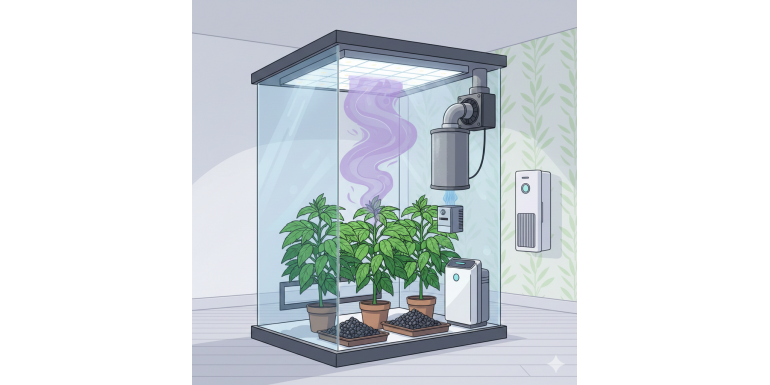
Odor Control in Indoor Growing – Carbon Filter, Ozone Generator or Odor Neutralizer?
In short: the basic method of controlling odors in indoor growing is a properly matched carbon filter working together with an exhaust fan. Odor neutralizers can be useful as additional support in the room, while ozone generators are specialist devices that require particular caution because of the properties of ozone.
Growing plants indoors is not only about controlling light, temperature and humidity. Odor control inside a grow tent, indoor greenhouse or grow room can also be important.
The most commonly used solutions include:
- carbon filters,
- odor neutralizers in gel or block form,
- ozone generators,
- a properly designed ventilation system.
Each of these solutions works in a different way and is intended for a different application. In this guide, we explain the difference between a carbon filter, an odor neutralizer and an ozone generator, and when each solution may be useful.
⏱ Reading time: around 8–10 minutes
The most important rule: odor control should start with proper ventilation. Even the best filter will not work correctly if the fan, filter and ducting are not properly matched.
Table of Contents
- Carbon filter – the basic method of odor removal
- How does an activated carbon filter work?
- How to match a carbon filter to a fan?
- Ozone generator – how does it work and when is it used?
- Is an ozone generator safe?
- Odor-neutralizing gels and blocks
- Carbon filter, gel or ozone generator – what should you choose?
- The most common odor-control mistakes
- FAQ – odor control in indoor growing
Carbon filter – the basic method of odor removal
A carbon filter is one of the most commonly used elements of a ventilation system in grow tents and indoor grow rooms.
Its purpose is to clean the air before it is exhausted from the growing area.
See available carbon filters for ventilation systems.
How does an activated carbon filter work?
Inside the filter there is activated carbon with a very large internal surface area.
As air flows through the filter, some of the compounds responsible for odor are retained on the surface of the carbon through a process called adsorption.
Adsorption should not be confused with absorption. Adsorption means that molecules are primarily retained on the surface of a material.
What determines the effectiveness of a carbon filter?
The most important factors are:
- the quality and amount of activated carbon,
- airflow speed,
- fan capacity,
- duct diameter,
- air humidity,
- the condition and age of the filter.
Important: very high airflow through an undersized filter can reduce adsorption efficiency. The air needs sufficient contact time with the activated carbon layer.
How to match a carbon filter to a fan?
The filter and fan should be treated as one ventilation system.
In practice, the most important things to compare are:
- the filter capacity expressed in m³/h,
- the capacity of the fan,
- duct connection diameter,
- air resistance in the system,
- the length and number of bends in the ducting.
A simple rule is that the nominal capacity of the filter should not be lower than the airflow of the fan used in the system.
It is also important to remember that the real airflow will be lower after adding a filter, ducting and bends than the free-air capacity stated for the fan alone.
How often should a carbon filter be replaced?
There is no single replacement interval that applies to every filter.
Service life depends, among other things, on:
- the quality of the activated carbon,
- how intensively the filter is used,
- humidity,
- the amount of contaminants in the air.
The most practical indicator is a noticeable drop in filtration effectiveness.
Ozone generator – how does it work and when is it used?
An ozone generator produces ozone, or O₃, which is a highly reactive form of oxygen.
Ozone reacts with many organic compounds, which is why it can be used in certain applications to neutralize odors and disinfect spaces.
See the available ozone generator.
Does an ozone generator replace a carbon filter?
Not necessarily, and in most typical grow-tent installations there is no need to treat an ozone generator as the primary odor-control method.
For most home systems, a properly selected carbon filter is a simpler and safer solution.
Is an ozone generator safe?
Warning: ozone at elevated concentrations is harmful to people and animals. Ozone generators should not be used in occupied spaces or directed into areas where people or animals are present.
Ozone can irritate the respiratory system and react with various materials and compounds present in the air.
For this reason, ozone-generating equipment requires considerably more caution than carbon filters or standard odor neutralizers.
Always follow the instructions provided by the manufacturer of the specific device.
Odor-neutralizing gels, blocks and sprays
Another group of products includes odor neutralizers such as the popular ONA range.
See the ONA odor neutralizers category.
They are most commonly available as:
- gels,
- blocks,
- sprays,
- products designed for use with fans or dispensers.
What is ONA Gel used for?
Products of this type work best as an additional odor-control solution in the room.
They can be useful, for example, for:
- temporary odors when opening a grow tent,
- odors in a technical or utility room,
- additional odor neutralization outside the main exhaust system.
Can an odor neutralizer replace a carbon filter?
No. A carbon filter cleans the stream of air passing through the ventilation system, whereas a gel or block works more locally in the room.
These are two different applications.
In practice: if the issue concerns air exhausted from the grow tent, start with a carbon filter. If the problem is odor lingering in the room itself, an odor neutralizer may be a useful addition.
Carbon filter, odor neutralizer or ozone generator – what should you choose?
| Solution | Main application | Ease of use |
|---|---|---|
| Carbon filter | Cleaning air in the exhaust ventilation system | Simple |
| Odor neutralizer | Additional odor control in the room | Very simple |
| Ozone generator | Specialist odor neutralization and disinfection | Requires strict safety precautions |
The best solution for a typical grow tent
For most standard installations, the most practical setup consists of:
- a properly sized exhaust fan,
- a carbon filter with suitable airflow capacity,
- properly routed ventilation ducting,
- an odor neutralizer only when additional room-level odor control is needed.
The most common odor-control mistakes
1. Using a filter that is too small
If the fan forces more air through the filter than the filter is designed to handle, odor-removal effectiveness may decrease.
2. Using exhausted activated carbon
A carbon filter does not last forever. Over time, the adsorption capacity of the activated carbon decreases.
3. Leaks in the ventilation system
If part of the air bypasses the filter through leaks, even a very good carbon filter will not solve the problem completely.
4. Ducting that is too long or heavily bent
Every bend and long section of duct increases airflow resistance.
5. Treating odor-neutralizing gel as a replacement for a filter
An odor neutralizer can help in the room, but it does not replace a carbon filter operating in the exhaust system.
6. Using an ozone generator carelessly
Ozone is not a standard air freshener. Ozone-generating devices require strict compliance with the manufacturer’s instructions and safety precautions.
FAQ – odor control in a grow tent
In most standard systems, a properly sized carbon filter is the primary and usually sufficient solution for cleaning air exhausted from a grow tent. Compare the airflow capacity of both devices and the duct connection diameter. The nominal airflow capacity of the filter should not be lower than the airflow produced by the fan in the system. Yes. Every filter creates airflow resistance, which means the real airflow of the system will be lower than the fan’s free-air rating. It depends on the type of filter, the quality of the activated carbon, airflow, humidity and operating conditions. Replace the filter when you notice a clear reduction in effectiveness. No. ONA Gel mainly works in the room, while a carbon filter cleans the air passing through the ventilation system. Ozone at elevated concentrations is harmful to people and animals. An ozone generator should only be used according to the manufacturer’s instructions and with appropriate safety measures. The most important element is a properly designed ventilation system: the right fan, a suitable carbon filter, airtight connections and correctly routed ducting. Is a carbon filter enough for a grow tent?
How do I choose a carbon filter for my fan?
Does a carbon filter reduce fan performance?
How long does a carbon filter last?
Can ONA Gel replace a carbon filter?
Can an ozone generator be used in a room?
What is the most important thing in odor control?
Summary – carbon filter, ozone generator or odor neutralizer?
In most indoor growing systems, the foundation of odor control should be a carbon filter working with a properly matched exhaust fan.
Odor neutralizers such as ONA can be a useful addition for the room, while ozone generators are more specialized solutions and require considerably greater caution.
The best approach is to work step by step:
- first check the ventilation capacity,
- then choose the correct carbon filter,
- eliminate any leaks in the system,
- only then consider additional odor-control methods.
Not sure which filter and fan to choose? Contact TanieUprawianie.pl and provide the dimensions of your grow tent, the duct diameter and the fan you currently use. We can help you select a compatible ventilation setup.