




Samsung LM301H EVO vs LM281B+ – what are the differences between these LED diodes?
11/19/2026 00:04:14 Lighting for plants
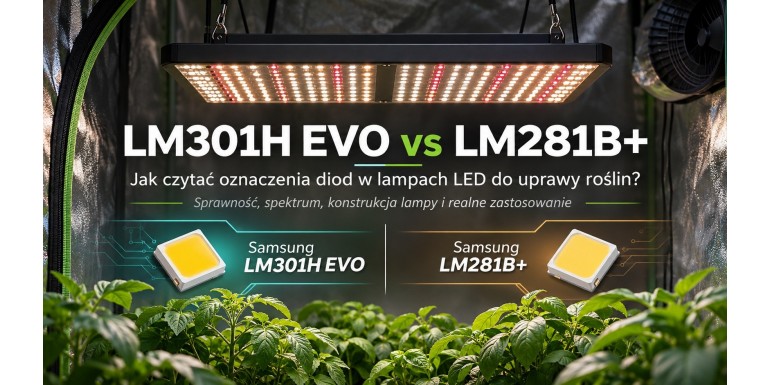
Samsung LM301H EVO and Samsung LM281B+ frequently appear in descriptions of LED grow lights. For someone choosing lighting, they may seem like a simple distinction between a “better” and a “cheaper” option, but in practice it is more complex. Both diode families are used in LED grow-light designs, and the actual result depends on more than the chips themselves. The driver, diode layout on the panel, spectrum, thermal management, power set by the manufacturer and matching the light to the growing area all matter as well.
In this article, we explain the key differences between LM301H EVO and LM281B+, show you how to read product descriptions and when it may be worth paying more for a higher-positioned light. If you are just getting familiar with the available technologies, our guide on how to light indoor plants may also be helpful.
LM301H EVO and LM281B+ – what do these names mean?
Samsung LM301H EVO is a family of efficient white LEDs designed for horticultural lighting. In the indoor grow-light segment, the “EVO” name is usually associated with premium solutions and high fixture efficacy. Samsung LM281B+, on the other hand, is a popular diode family used in lights across different budgets and power ratings. It can be a sensible choice, especially when the fixture is well designed and correctly matched to the grow tent.
It is worth being cautious when comparing symbols alone. A diode model designation is not a complete light specification. The same type of chips can be used in fixtures with different build quality, different diode counts, different drivers and entirely different coverage areas.
The key difference: efficiency potential
The most commonly cited advantage of LM301H EVO is its higher potential photon efficacy compared with popular solutions from earlier generations or lower classes. Put simply, a well-designed light with EVO diodes can provide more plant-useful light at the same power draw than a design based on less efficient chips.
However, this does not mean that every fixture labelled “EVO” will automatically be better than every LM281B+ model. The differences visible in finished products may be smaller or greater than the diode name alone suggests. The light manufacturer must still make proper use of the chips’ potential by providing suitable cooling, sensible drive current and an even distribution of light sources.
Why manufacturer figures need context
When reading grow-light descriptions, look at fixture efficacy, usually expressed in µmol/J, but compare it only under similar conditions and using information provided for the complete light. Specifications for an individual diode in the chip manufacturer’s documentation are not the same as the performance of a finished fixture.
Final efficacy is affected by, among other things:
- the efficiency and quality of the LED driver,
- diode operating temperature and heatsink design,
- the current used to power the chips,
- the proportion of white diodes and supplementary spectrum ranges,
- losses in optics or covers, where present,
- the light’s actual power draw from the wall socket.
Comparing LM301H EVO and LM281B+ in practice
| Feature | Samsung LM301H EVO | Samsung LM281B+ |
|---|---|---|
| Positioning | A solution associated with the efficient LED grow-light segment | A popular diode family used in lights across a wide range of prices and power ratings |
| Efficiency potential | High, provided the fixture design makes good use of the diodes’ capabilities | Good, depending on the design of the specific fixture |
| What it means when buying | May be an argument for choosing a premium light | Does not rule out a light – assess the whole product |
| Best way to assess it | Compare actual power, coverage, dimmer, driver and fixture data | Compare actual power, coverage, dimmer, driver and fixture data |
The key conclusion from the table is simple: LM301H EVO gives a light designer a very good starting point, but LM281B+ can still be used in a functional and cost-effective fixture. It is not worth making a decision based solely on one line in a product description.
Spectrum: white diodes are only part of the system
Many lights use white diodes as the spectrum base and then add red diodes, sometimes far-red, UV or other components. This arrangement is intended to create light that is useful through successive stages of plant development. The LM301H EVO or LM281B+ label alone does not tell you what the fixture’s full spectrum looks like.
In practice, check whether the manufacturer clearly communicates the intended use of the light, its coverage area and available functions. It is also worth confirming whether power adjustment is available. Dimming makes it possible to reduce light intensity during the early stage of plant development, then increase it as needs and ventilation capacity increase.
An example of a light described as using Samsung LM301H EVO chips is the AC Infinity IONFRAME EVO3 280W. Among models using the LM281B family, you can consider the LUCKYGROW FLEX 720W with Samsung LM281B diodes. However, they should not be compared based on their diodes alone: they differ in power class and are intended for different growing areas.
Why light design matters as much as the chip
LEDs perform best under specific thermal and electrical conditions. This is why the quality of the LED board, heatsink, driver and connections directly affects operating stability and practical performance. A good light distributes illumination as evenly as possible across the growing area instead of creating a very intense central hotspot and clearly weaker zones around the edges.
Light distribution and grow-tent size
Before buying, determine the dimensions of your growing space. Even a very efficient light will not meet expectations if its coverage does not suit the grow box. A fixture that is too small will leave the edges underlit, while a light that is too powerful and hung low may require substantial dimming or a greater distance from plant tops.
For medium-sized setups, browse the 100W–300W LED grow lights category; for larger tents, the 300W–600W LED grow lights range provides a useful reference point. Filtering this way makes selection easier before you start analysing the type of diodes used.
Cooling and durability
Efficient diodes do not eliminate the need to control temperature. Heat generated by the light must be dissipated, and the temperature in the tent should remain under control. Passive designs operate without a fan in the fixture itself, while others use active cooling. Each option should be assessed in relation to the conditions in the particular room, airflow and acoustic comfort.
Is it worth paying more for a Samsung LM301H EVO light?
Paying more can make sense when you are building an energy-efficient setup for years to come, value high-quality components and choose a light with specifications suited to your own growing area. In this situation, EVO technology is one argument in favour of a particular model, but it should not be the only one.
Compare lights in terms of actual power, stated coverage area, adjustment options, build quality, warranty terms and available budget. The AC Infinity IONFRAME EVO4 300W is an example of a fixture intended for areas up to 120 × 120 cm according to its product name. If you are looking for a lower-power design, you can also check the Spider Farmer SF2000 200W with Samsung LM301B EVO. LM301B EVO is a different designation from LM301H EVO, so read the complete description of a given model rather than automatically treating all EVO labels as equivalent.
When is LM281B+ a sensible choice?
A light based on LM281B+ can be a good choice if it provides suitable power for your tent, even light distribution and the functions needed for day-to-day growing. Especially on a limited budget, the key is to buy a fixture correctly matched to the growing area rather than the most advanced chip in a light that does not suit the conditions.
Among models with Samsung 281B diodes, there are also solutions with additional light ranges, such as the GOAT LED 240W UV+ Board Wide Samsung 281B. Treat supplementary spectral components as part of the overall design, not as a replacement for properly selected power, mounting distance, watering and climate control in the grow box.
How to choose an LED grow light wisely – a short checklist
- Measure the growing area – match the light to the dimensions of the tent, not just its wattage.
- Check actual power draw – do not rely on marketing names or substitute claims.
- Assess diode type and layout – the whole arrangement matters, not only the chip designation.
- Look for power adjustment – a dimmer provides more flexibility at different stages of plant development.
- Factor in temperature – the light and ventilation need to work together in a limited space.
- Compare products in the same class – models with extremely different wattages or coverage are not direct competitors.
- Look after eye comfort – when working under intense light, LED and HPS grow-light glasses can be helpful.
FAQ: Samsung LM301H EVO vs LM281B+
Is LM301H EVO always better than LM281B+?
Not in every practical comparison. LM301H EVO has high efficiency potential, but the quality of a finished light also depends on the driver, cooling, spectrum, power and the design of the entire fixture. A well-matched LM281B+ light can be a better purchase than an EVO model that is poorly suited to your setup.
Does diode type determine plant yield?
Not by itself. Lighting is important, but growing results also depend on light intensity and uniformity, lighting duration, temperature, humidity, air circulation, watering and plant nutrition.
Which parameters should you check beyond the diode name?
Check actual power, suggested coverage area, dimming capability, cooling method, driver type and spectrum information. If the manufacturer publishes reliable data for the complete fixture, it can make comparing models easier.
Are lights with LM281B+ suitable for the whole plant development cycle?
It depends on the design of the specific light and its intended use as defined by the manufacturer. The LM281B+ designation alone cannot determine this. Check the fixture description, spectrum, power and recommended coverage area.
Summary
Samsung LM301H EVO and LM281B+ are not simple labels for “good” and “bad”. LM301H EVO represents a technology valued for its high efficiency potential and is often found in higher-end lights. LM281B+, meanwhile, remains a practical solution used in many effective LED grow fixtures. You will make the best decision by analysing the complete light: its power, coverage, light distribution, controls, operating temperature and suitability for your growing space.