




VPD in a Grow Tent – What Is It and How Do You Match Temperature to Humidity?
10/12/2026 23:58:14 Poradniki
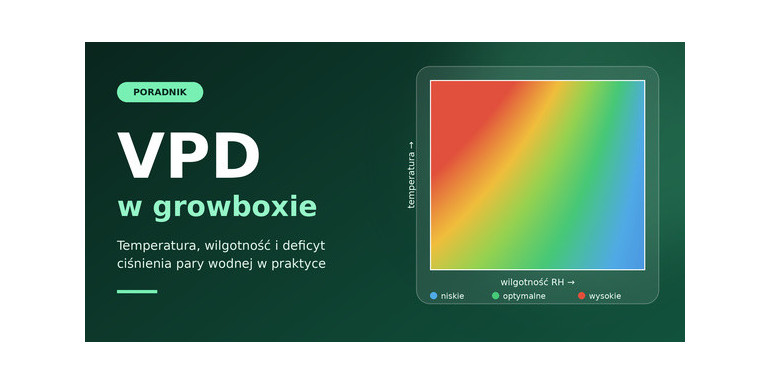
Temperature and humidity in a grow tent always work together. The same relative humidity can mean completely different conditions for a plant when the air or leaf temperature changes. This is why it is useful to understand VPD (Vapour Pressure Deficit). This parameter helps you view the microclimate as a whole: not only through the number displayed on a hygrometer, but also through the plant’s ability to transpire.
What Is VPD?
VPD, or vapour pressure deficit, describes the difference between the amount of water vapour that air could hold at a given temperature and the amount that is actually present in it. It is usually expressed in kilopascals (kPa).
In practice, VPD indicates how strongly the air draws water from leaf surfaces. When the air is warm and dry, VPD rises and the pressure on transpiration becomes greater. When conditions are cool and very humid, VPD drops, making it harder for water to evaporate from the leaves.
This distinction matters because relative humidity (RH) alone does not provide the full picture. RH depends on temperature: air at 28°C and 60% humidity does not create the same environment as air at 20°C and 60% RH.
Why Does VPD Matter in a Grow Tent?
Plants take up water and mineral nutrients through their root system and transport them to the above-ground parts. Transpiration, meaning the evaporation of water through stomata, is one part of this process. Air conditions can either support or limit it.
- VPD that is too low usually means air that is too humid or too cool. Transpiration may then be weaker, while prolonged humidity increases the risk of issues associated with stagnant moisture.
- VPD that is too high is typical of air that is too dry and/or hot. The plant may lose water faster than it can effectively replenish it, especially if the root zone is not functioning properly.
- Stable VPD makes it easier to maintain predictable conditions. Instead of reacting to a single humidity reading, you can consciously balance temperature, RH, air circulation and growing-medium moisture.
VPD does not replace plant observation. It is a useful supporting tool that should be considered together with leaf condition, the drying rate of the growing medium, airflow and conditions around the roots.
Temperature, Humidity and VPD – How to Read the Relationship
In the simplest terms: increasing temperature while keeping relative humidity unchanged raises VPD. To maintain a similar VPD at a higher temperature, you will usually need to increase RH. The reverse applies when lowering the temperature: with cooler air, the same RH results in lower VPD.
| Change in conditions | Typical effect on VPD | What to check |
|---|---|---|
| Temperature rises, RH unchanged | VPD rises | Whether the air is drying plants excessively and whether the growing medium is keeping up with water demand |
| Temperature drops, RH unchanged | VPD drops | Whether moisture is lingering too long within the plant canopy |
| RH rises, temperature unchanged | VPD drops | Ventilation, air circulation and condensation on cool surfaces |
| RH drops, temperature unchanged | VPD rises | Whether leaves show stress linked to excessive evaporation |
VPD charts found online are usually based on air temperature. A more accurate analysis takes leaf temperature into account, as it can differ from the measured air temperature under LED lights, strong airflow or near a heat source. Therefore, a single kPa value should not be treated as a rigid target detached from actual growing conditions.
How to Match Temperature and Humidity at Different Stages
There is no single universal temperature and RH combination suitable for every plant, cultivar and growing method. A useful principle, however, is to adapt conditions to plant size, light intensity, root development and canopy density.
Seedlings and Young Plants
Young plants have limited root systems and delicate leaves. They usually respond well to moderate temperatures and relatively higher humidity than mature plants. Such conditions limit excessive water loss before the roots can efficiently supply the above-ground parts.
However, higher humidity should not be confused with a lack of air exchange. A grow tent needs gentle air movement and regular exchange, without a direct, strong airflow aimed at young leaves.
Vegetative Stage
During intensive root and leaf development, humidity can be gradually reduced or temperature increased if VPD conditions call for it. Make changes slowly while observing how plants respond. A sudden shift from high RH to very dry air can be more problematic than the target humidity level itself.
At this stage, reliable readings taken at canopy level are especially useful. Browse the temperature and humidity measurement category to monitor the core environmental parameters rather than relying on how the room feels.
Mature Plants and Dense Canopies
As leaf mass and plant density increase, circulation and moisture removal become particularly important. Air inside a tight canopy may be more humid than indicated by a sensor positioned outside it. In these conditions, maintaining very high RH can be risky, especially when the temperature periodically drops after the lights switch off.
It is worth remembering that a nighttime temperature drop automatically lowers VPD. If humidity is not adjusted accordingly, conditions that encourage water condensation on surfaces may occur. The goal is stability, not aggressive drying of the entire space.
How to Measure VPD Correctly
To estimate VPD, you primarily need temperature and relative humidity readings. Some devices display VPD directly, but always check where the sensor is positioned and whether its reading represents the actual conditions around the plants.
A practical option can be a VIVOSUN Bluetooth VPD thermometer-hygrometer, which combines temperature and humidity measurement with a VPD reading. For more advanced growing setups, sensors that record changes over time can also be useful, such as the AirComfort Bluetooth smart temperature and humidity sensor. Reading history helps reveal whether an issue occurs after the lights turn on, while the extraction fan is operating or during the dark phase of the cycle.
Place the sensor close to the plant tops, but not directly under the light, in the path of a strong fan stream or beside the tent wall. In a large grow tent, differences between zones can be noticeable, so one reading does not always describe the entire space.
How to Adjust VPD in Practice
The safest approach is to change one factor at a time and observe the result for a sufficiently long period. Sharp adjustments to temperature and RH often cause more instability than a slightly imperfect but consistent value.
When VPD Is Too High
- Check whether canopy temperature is too high compared with the rest of the grow tent.
- Consider moderately increasing humidity if the plant stage and air circulation allow it.
- Verify the intensity and direction of airflow: a strong stream constantly hitting leaves can increase evaporation.
- Assess the condition of the growing medium and roots; poor water uptake is not always caused by air parameters.
When VPD Is Too Low
- Improve air exchange and mixing throughout the tent.
- Where justified, gradually reduce RH or gently raise the temperature.
- Monitor humidity especially after lights switch off, when temperatures fall.
- Remove sources of excess moisture, such as standing water, wet surfaces or a growing medium that dries too slowly.
Automation can reduce fluctuations, but it cannot replace proper system configuration. One example of equipment that supports ventilation is the AC Infinity Quiet Inline Fan with temperature and humidity controller. If overly dry air is the issue, a Cornwall Electronics humidity controller may also be helpful when connected and set up according to the manufacturer’s instructions.
Ventilation, Light and Leaf Temperature
VPD is not determined solely by the reading on a hygrometer. Lighting, airflow, growing-medium temperature and leaf temperature also affect it. Strong light can increase plant activity while also changing leaf surface temperature. Intensive extraction, in turn, can replace air quickly and remove humidity along with it.
When a grow tent becomes too hot, do not try to compensate for the entire problem simply by raising humidity. First identify the source of excess heat and improve the fundamentals of climate control. Helpful guidance can be found in our article: How to Lower the Temperature in a Grow Tent.
A well-functioning setup is a compromise: fresh air, gentle circulation among the leaves, stable temperature and RH suited to the current growing stage. Focusing too heavily on a single VPD number can lead you to overlook more important signals, such as condensation, overheated plant tops or watering problems.
Common Mistakes When Working with VPD
- Treating RH as an independent target. Always interpret humidity in relation to temperature.
- Ignoring the dark phase. After the lights turn off, conditions change quickly and relative humidity often rises.
- Measuring near a wall or light. A reading from these locations may not reflect conditions around the leaves.
- Making large, frequent adjustments. Environmental stability is usually more important than constantly chasing an ideal value.
- Overlooking the root zone. A plant will not make full use of favourable VPD if its roots are weakened, waterlogged or too dry.
FAQ – VPD in a Grow Tent
Is VPD More Important Than Temperature and Humidity?
VPD does not replace temperature or humidity. It is a way of interpreting their combined impact on transpiration. Both parameters still need to be monitored, along with proper ventilation and air circulation.
Can You Maintain Ideal VPD Throughout the Day?
In practice, conditions change with lighting, ventilation and ambient temperature. A more realistic goal is to limit major swings and keep parameters within a safe range for the relevant development stage.
Why Does Humidity Rise After the Lights Turn Off?
As temperature drops, air can hold less water vapour. The same amount of moisture then produces a higher RH percentage, making very low VPD and condensation more likely at night.
Does a Circulation Fan Lower VPD?
Air movement alone does not directly change temperature and RH readings in the same way as dehumidification or heating. However, it affects the air layer around the leaf and the rate of evaporation, so its strength and direction should be selected carefully.
How Do You Know Whether the Sensor Is Positioned Correctly?
Ideally, position it at plant canopy height in a location representative of the crop. Avoid contact with wet surfaces, direct light and strong airflow. In larger tents, it is worth comparing readings from different points from time to time.
Summary
VPD in a grow tent brings temperature and humidity together in one practical indicator. It helps assess whether the air is drying plants excessively or, conversely, restricting transpiration through cool conditions and high RH. The best results come not from chasing one ideal number, but from a stable climate, accurate measurement at canopy level, suitable circulation and gradual adjustments to conditions.