




Greenhouse Supplemental Lighting – How to Choose Grow Lights?
11/03/2026 08:16:02 Poradniki , Lighting for plants
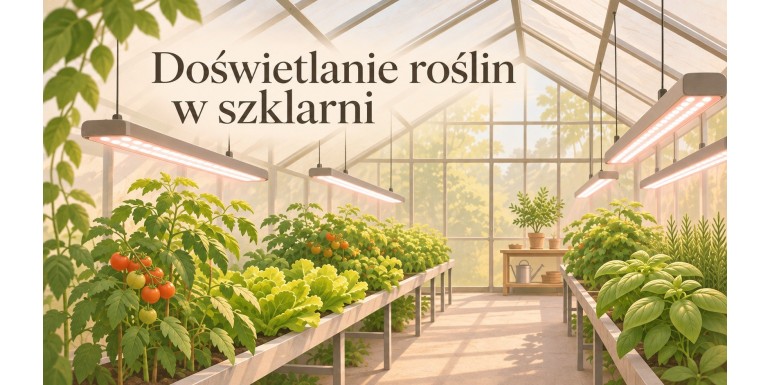
Supplemental lighting in a greenhouse makes it possible to use the space more effectively when days are short and sunlight is limited. This mainly applies to autumn, winter and early spring, but extra light can also be useful in summer—for example, during prolonged cloudy weather or when raising seedlings. Well-planned lighting does not completely replace sunlight; it supplements what is missing. To work effectively, the lights, operating time, hanging height and conditions under cover need to match the plant species and stage of development.
Why use supplemental lighting in a greenhouse?
Plants use light for photosynthesis, the process through which they produce compounds needed for growth. When there is too little light, growth can slow down and shoots may stretch excessively as they seek a brighter position. In seedlings, this often appears as weak, less stable young plants. For fruiting plants, insufficient light can affect the pace of development and overall condition.
Conditions in a greenhouse are better than outdoors because plants are protected from wind and some precipitation. However, glazing, film covers, dirt on the structure, condensation and short winter days can still limit the amount of radiation reaching the leaves. This is when supplemental light becomes useful.
The basics of the relationship between light and plant growth are explained in why light is crucial for plants. In practice, the key is to observe your plants and respond to current conditions rather than follow one rigid schedule throughout the year.
When does greenhouse supplemental lighting make the most sense?
Additional lights are most useful when natural light is clearly lower than plants need. The most common situations include:
- raising seedlings in winter and early spring,
- growing ornamental and edible plants during autumn and winter,
- cloudy weeks when little daylight reaches the greenhouse,
- shaded locations caused by buildings, trees or neighbouring structures,
- uneven lighting across beds and benches in a larger greenhouse.
Not every plant needs the same level of support. Species with high light requirements usually need more of it than plants that tolerate partial shade well. The growth stage also matters: young plants should not be exposed to overly intense light without proper acclimatisation, while plants in their generative stage may also respond to day length.
Which lights work well in a greenhouse?
For modern supplemental lighting, LED fixtures designed for plant cultivation are most commonly chosen. Their advantage is the ability to provide a spectrum useful to plants, along with relatively low heat output compared with some older technologies. This does not mean that an LED fixture will not raise the temperature—every fixture releases energy as heat, so the greenhouse microclimate still needs to be monitored.
When choosing, it is worth looking at lighting for plants, but your decision should not be based solely on wattage. Power drawn from the mains does not describe light uniformity, coverage area or how the fixture will perform above a particular crop.
What should you look for when choosing a fixture?
- Coverage area – the fixture should suit the size of the bed, bench or greenhouse section.
- Light distribution uniformity – especially important for seedlings and plants grown in rows.
- Adjustment options – useful when plants are at different growth stages or the amount of sunlight changes.
- Resistance to greenhouse conditions – humidity, dust and temperature changes require careful equipment selection and installation.
- Mounting method – the structure must safely support the lights and allow their height to be adjusted.
For many applications, LED grow lights are a good starting point. If you plan to illuminate a larger part of the structure, comparing fixtures in the 300W–600W LED grow lights range may be helpful. Always relate the specific solution to the growing area, greenhouse height, and the number and type of plants.
Light intensity, operating time and photoperiod
Effective supplemental lighting depends on two related factors: the intensity of light reaching the leaves and the length of time plants are illuminated. Very weak light over a very long period will not always solve a light shortage, while overly intense light placed too close can stress plants. The aim is to find a balance.
The photoperiod, or light-day length, is particularly important for species that respond to the duration of day and night. Do not assume that round-the-clock lighting is a universal solution. Plants also need a period of darkness, and the appropriate rhythm should be matched to the species, variety and cultivation goal.
A practical solution is to use a timer. This allows lights to switch on at fixed times, so the grower does not need to remember to turn the lighting on and off manually. On very bright days, the schedule can be adjusted if the installation allows it.
How can you assess whether plants are getting enough light?
The most reliable method is to take measurements with a suitable meter and interpret the result according to the requirements of the particular plant. Learn about the role of monitoring equipment in our guide to essential measuring tools in plant cultivation. Measurements help compare light levels in different parts of the greenhouse, check the effect of fixture hanging height and identify underlit zones.
Regular observation is also helpful. Excessive shoot stretching, long gaps between nodes, smaller leaves or plants leaning towards the brighter side of the greenhouse may indicate insufficient light. On the other hand, signs of stress appearing just after changing the light setup should prompt you to check the fixture distance, lighting duration and temperature around the plant tops.
Positioning lights in a greenhouse
Even a good light will not do its job if it is hung at random. Fixtures should be positioned so that light reaches the entire planned area as evenly as possible. In longer greenhouses, several correctly spaced light points often work better than one fixture hung high above the centre.
The mounting height should allow adjustment as the plants grow. Always follow the manufacturer’s recommendations for the specific fixture. It is not worth guessing the optimal distance based on general advice online, as different models have different diode layouts, lenses, output and recommended coverage areas.
Dividing the greenhouse into sections works well. Separate circuits or schedules make it possible to manage seedlings, plants with lower requirements and intensively lit areas differently. This also helps reduce energy use, as lights operate only where they are genuinely needed.
Temperature, humidity and ventilation with supplemental lighting
Light is only one part of the growing environment. Once lights are switched on, the temperature near plants can rise, while temperature differences between day and night may encourage condensation. High humidity that persists for too long increases the risk of plant health problems, so supplemental lighting should be planned together with air exchange.
Properly selected ventilation for growing plants helps reduce stagnant humid air, equalise temperature and maintain gentle air movement among plants. However, a fan should not continuously blow a strong stream directly onto delicate leaves or seedlings.
Watering is equally important. With more light, plants may change the rate at which they take up water, but this is not a reason to water “just in case”. Monitor substrate moisture, growth stage and weather conditions. In larger setups, plant irrigation systems can help provide water consistently.
Safe installation of a lighting system
A greenhouse is a high-humidity environment, so the electrical installation requires particular care. Lights, cables, connectors and controllers should be selected and installed according to their intended use and the manufacturer’s instructions. Route cables away from places where they could come into contact with standing water, be stepped on or become damaged while working around plants.
- Use stable brackets and hangers suited to the weight of the fixtures.
- Do not overload a single electrical circuit.
- Protect connections from humidity and accidental splashing.
- Regularly check cables, fittings and plugs.
- If you have any doubts about the installation, ask a qualified electrician for help.
It is also worth considering your own comfort while working with grow lights. If you enter the greenhouse while high-brightness fixtures are operating, LED and HPS grow light glasses selected for your working conditions may be helpful.
Common mistakes when adding greenhouse lighting
Most often, the problem is not the absence of a light itself, but the lack of a plan for using it. Common mistakes include choosing a fixture without considering the area, uneven placement of light sources, failing to monitor temperature, overlooking ventilation and using identical settings all year round.
Another mistake is treating supplemental lighting as the only factor that determines cultivation success. Light will not compensate for incorrect watering, substrate that is too cold, poor air circulation or nutrition problems. Plants respond best to stable conditions managed comprehensively.
FAQ: supplemental lighting in a greenhouse
Does every greenhouse plant need supplemental light?
No. The need for supplemental lighting depends on the species, season, amount of natural light and cultivation goal. During periods with plenty of sunshine, additional lights may be unnecessary, while they can be very helpful for raising seedlings in winter.
Can an LED grow light be used in a greenhouse?
Yes, provided the fixture is designed for such conditions and the installation has been completed safely. Pay particular attention to humidity, cable protection, stable hanging and proper ventilation.
How long should a light run over plants?
There is no single value for every crop. Operating time depends on the species, growth stage, amount of sunlight and light intensity. Set a schedule that considers the plants’ natural rhythm and observe their response.
Why are plants still stretching despite using a light?
The cause may be too little light intensity at leaf level, uneven coverage of the area, an unsuitable fixture hanging height or unfavourable accompanying conditions, such as excessively high temperature.
Do plants need more frequent watering with supplemental lighting?
Not necessarily in every case, but water requirements may change. Instead of watering on a fixed schedule, check the substrate moisture and plant condition. Also take temperature and air humidity in the greenhouse into account.
Summary
Supplemental lighting in a greenhouse is a practical way to make up for insufficient light during more challenging parts of the season. The best results come from combining well-chosen LED grow lights, thoughtful fixture placement, regular condition monitoring, and effective ventilation and irrigation. Before buying lighting, determine the growing area, plant requirements and the technical capabilities of the greenhouse. This ensures that additional light becomes genuine support rather than a random expense.