



When to harvest? How to recognise the ideal moment for harvesting + lunar calendar 2026
02/13/2026 09:19:26 Informacje , CBD Cultivation
When to Harvest Plants? How to Recognize the Ideal Harvest Time + 2026 Lunar Calendar
Disclaimer: This material is for educational purposes and concerns legal cultivation and plant materials permitted under applicable law. Always check local regulations, contractual requirements where cultivation is intended for commercial collection, and the parameters of the specific variety provided by the producer.
When is the best time to harvest plants? There is no single date suitable for every variety and every grow. The best harvest time depends mainly on the actual maturity of the plant, the expected finishing time of the variety, the condition of the flowers and the weather. A lunar calendar may serve as an additional guideline, but it should never replace direct observation of the plant.
In practice, harvest timing is a combination of several factors: plant maturity, weather, humidity, plant health and the intended use of the harvested material. Plants intended for fibre are treated differently from those grown for biomass or seed production.
The lunar calendar may be useful as a “second layer” of planning. If the plant is already ready and you have several similar days to choose from, the Moon phase can also be considered. However, it makes little sense to delay harvesting during prolonged rainfall or high humidity simply because a more favourable lunar phase is expected a few days later.
Short answer: first check the estimated finishing time of the variety and the plant's actual maturity, then check the weather, and only after that consider the lunar calendar. If all three factors line up, you have a very good harvest window.
Estimated reading time: 9–12 minutes.
Table of contents
- 3 most important rules before harvest
- Lunar calendar and harvesting
- Waning Moon harvest windows in 2026
- Outdoor 2026 – most important months
- How to tell when the plant is ready
- How to interpret the producer's estimated finishing time
- Trichomes as a maturity indicator
- What if the plant matures unevenly?
- Weather and humidity
- Does the time of day matter?
- When to harvest for fibre
- When to harvest for seeds
- Most common mistakes
- Pre-harvest checklist
- FAQ – frequently asked questions
- Summary
3 rules that really matter before harvest
One of the biggest mistakes is trying to find one magical harvest date. In reality, the decision should be based on several signals that confirm one another.
- Do not harvest only according to the calendar. First assess the real maturity of the plant. A calendar may help you choose a day, but it does not determine biological maturity.
- Treat the producer's estimate as a reference point. Temperature, light intensity, weather and general growing conditions can all shift the actual finishing date.
- For outdoor cultivation, weather is extremely important. A dry weather window can be much more valuable than a theoretically ideal Moon phase.
It is usually better to think of harvest as a multi-day maturity window rather than one exact date. When the major signs show that the plant is nearing the end of its cycle, you normally have some flexibility to match the harvest with the weather and your own logistics.
Lunar calendar and harvesting – how should it be interpreted?
Lunar calendars have long been used in gardening, fruit production and biodynamic agriculture. They should not, however, be treated as a replacement for observing the plant itself.
The most common traditional rule is to choose the period when the Moon is waning, meaning from the Full Moon to the New Moon.
- Most commonly chosen harvest window: the waning Moon.
- Often avoided: the exact day of the Full Moon.
- Practical priority: a dry day without rain, excessive humidity or heavy dew.
This does not mean that harvesting during another Moon phase is automatically wrong. The lunar calendar is primarily an additional planning tool for situations in which the plant is already biologically ready.
Practical decision hierarchy:
1. plant maturity,
2. plant health,
3. weather forecast,
4. ability to carry out the harvest efficiently,
5. Moon phase.
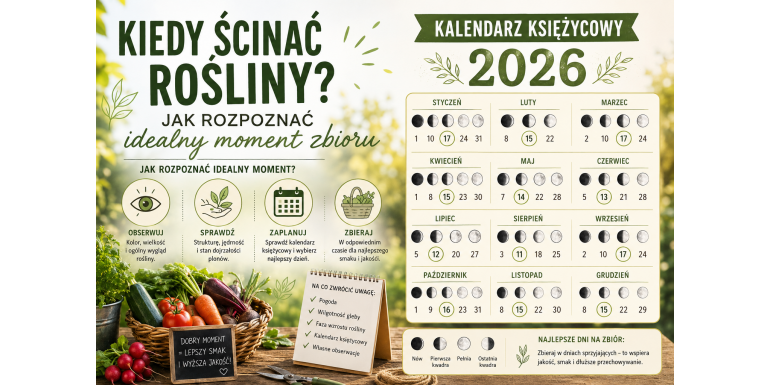
Waning Moon harvest windows – full year 2026
The table below shows approximate windows based on the Full Moon → New Moon rule. These dates should not be treated as automatic harvest dates.
If the plant is ready and the weather is stable, the relevant period may be used as an additional guide when selecting a specific day.
| Cycle | Full Moon | New Moon | Harvest window – waning Moon |
|---|---|---|---|
| January | 03.01 11:04 | 18.01 20:53 | 04.01–17.01 |
| February | 01.02 23:10 | 17.02 13:03 | 02.02–16.02 |
| March | 03.03 12:39 | 19.03 02:26 | 04.03–18.03 |
| April | 02.04 04:13 | 17.04 13:54 | 03.04–16.04 |
| May I | 01.05 19:24 | 16.05 22:03 | 02.05–15.05 |
| May II | 31.05 10:46 | 15.06 04:56 | 01.06–14.06 |
| June / July | 30.06 01:58 | 14.07 11:45 | 01.07–13.07 |
| July / August | 29.07 16:37 | 12.08 19:37 | 30.07–11.08 |
| August / September | 28.08 06:19 | 11.09 05:27 | 29.08–10.09 |
| September / October | 26.09 18:50 | 10.10 17:50 | 27.09–09.10 |
| October / November | 26.10 05:13 | 09.11 08:02 | 27.10–08.11 |
| November / December | 24.11 15:55 | 09.12 01:52 | 25.11–08.12 |
| December | 24.12 02:29 | New Moon falls in 2027 | 25.12–31.12 |
Full Moon and New Moon dates and times according to the Polish time zone. Sources listed in the original material: KalendarzSwiat and Timeanddate for Warsaw.
Outdoor 2026 – key harvest windows from July to October
In Central European conditions, most outdoor harvest interest usually falls at the end of summer and during autumn. At this stage, weather can become just as important as biological maturity.
- JULY: 01.07–13.07 and 30.07–31.07.
- AUGUST: 01.08–11.08 and 29.08–31.08.
- SEPTEMBER: 01.09–10.09 and 27.09–30.09.
- OCTOBER: 01.10–09.10 and 27.10–31.10.
September and October can bring highly changeable conditions. Long periods of damp weather, cold nights, fog and repeated rainfall can increase the risk of plant health problems.
This is why outdoor growers should never rely only on the date. If the plant is already mature and the forecast shows several dry days before a longer rainy period, weather conditions may justify selecting an earlier day within the available harvest window.
How to tell when the plant is ready
The most reliable assessment comes when several different signals begin to point in the same direction.
1. The expected finishing time has been reached
The producer's information provides the first reference point. However, it does not mean that every plant will finish on exactly the same day.
2. The plant clearly slows down
Towards the end of the cycle, the formation of new growth often slows noticeably. The plant no longer looks as active as it did during the most intensive development stage.
3. The flowers change in appearance
Flowers may become fuller and denser, while new growth appears more slowly.
4. Water uptake may decrease
Some plants begin to consume water more slowly near the end of the cycle. This is not a stand-alone maturity indicator, but together with other signs it can confirm that the plant is approaching its final stage.
5. Natural fading appears
Gradual ageing and yellowing of some leaves can be a natural part of the end of the cycle. It should, however, be distinguished from nutrient deficiencies, overwatering, disease or root problems.
6. Resin structures begin to change
Observing trichomes can provide an additional indication of the maturity of different parts of the plant.
How accurate is the producer's stated finishing time?
It should not be treated like a clock counting down to one exact day.
Producer estimates are usually approximate and assume certain growing conditions. Actual development may depend on:
- temperature,
- light intensity,
- genetics of the individual plant,
- root-zone conditions,
- water and nutrient availability,
- environmental stress,
- weather conditions in outdoor cultivation.
The stated finishing time is therefore best treated as the point at which closer observation should begin, not as an automatic cutting date.
Good practice: the closer you get to the expected finishing time, the more frequently you should inspect the whole plant. Do not make the decision based on one feature alone.
Trichomes – one of the most useful maturity indicators near the end
Trichomes are tiny glandular structures present on the surface of the plant. Their appearance can provide a useful indication of the stage of maturity.
A magnifying glass, jeweller's loupe or small microscope can make observation easier.
- Clear – usually indicate an earlier stage of development.
- Cloudy or milky – indicate a more advanced stage of maturity.
- Amber – indicate further maturation and ageing of some of the resin structures.
The most important thing is to observe the overall trend across the plant rather than focusing on one isolated spot.
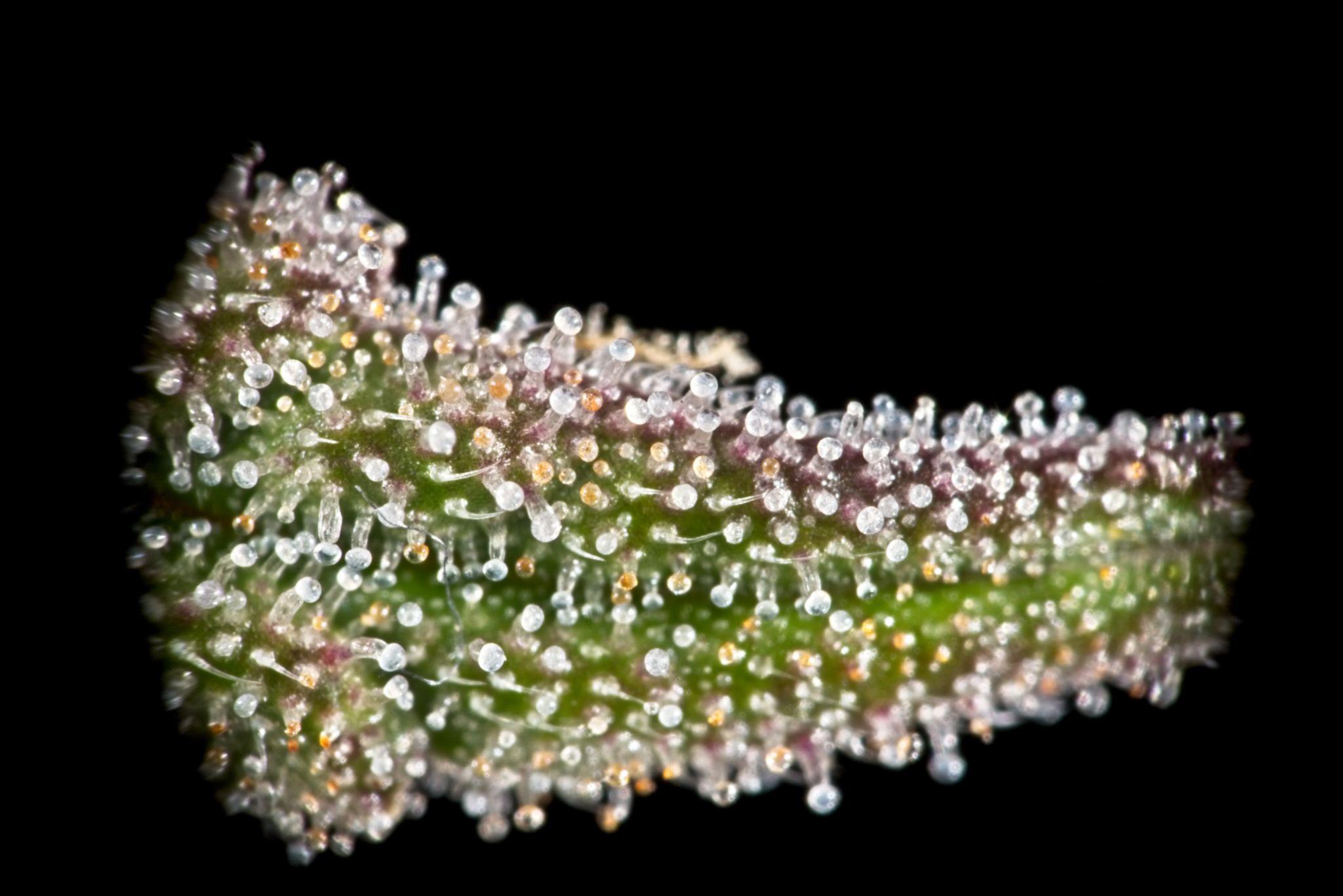
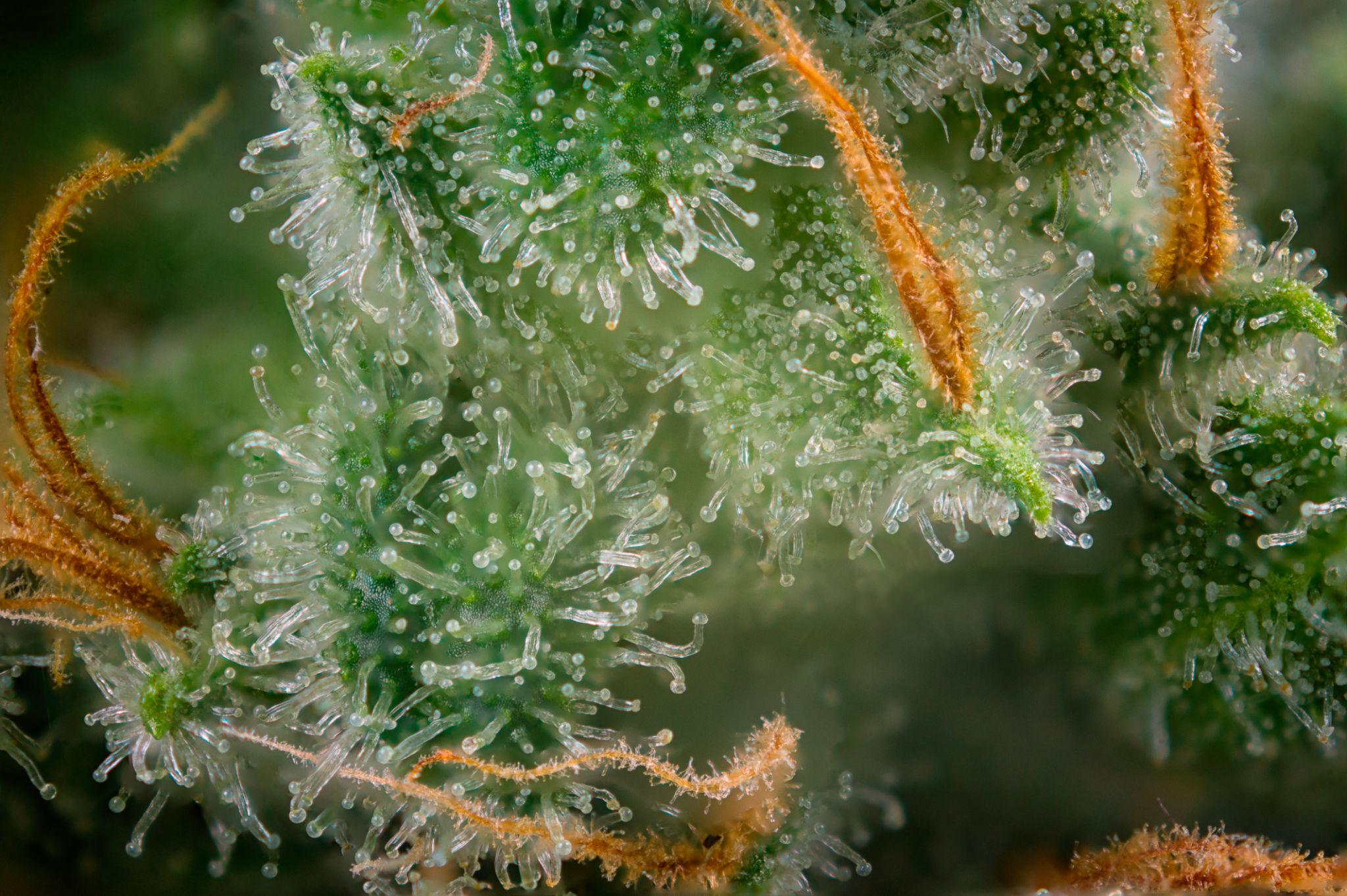
Practical tip: do not inspect only one area. Upper and better-lit parts of the plant may mature at a different rate than lower sections.
What if the plant matures unevenly?
This is completely normal, especially with large outdoor plants. Upper sections usually receive more light and may develop differently from the lower parts.
It is therefore useful to compare:
- the main top,
- the middle part of the plant,
- one or two lower sections.
If you inspect only the most mature top, you may get a misleading picture of the entire plant. On the other hand, looking only at less-developed lower sections may make the whole plant appear less mature than it really is.
The decision should therefore be based on the overall condition of the plant.
Weather and humidity – why they can matter more than any calendar
For outdoor cultivation, the end of the season often becomes a race between maturity and worsening weather.
The most favourable conditions usually include:
- several dry days before the intended harvest,
- no heavy rainfall,
- limited dew,
- moderate air humidity,
- good air movement,
- a stable forecast for the following 24–48 hours.
During autumn, special attention should be paid to the combination of low temperatures and high humidity. Dense flowers may dry very slowly after rain, which can increase the risk of fungal problems.
What matters more: the Moon phase or the weather?
If you have to choose, plant safety and suitable weather conditions should come first.
There is little sense in leaving a mature plant outside through several days of heavy rain only because a theoretically more favourable lunar date is approaching.
Does the time of day matter?
In outdoor cultivation, the difference in moisture between early morning and later in the day can be substantial.
In the early morning, plants may be covered with dew. If there is no other reason to harvest immediately, it can be sensible to wait until the surface of the plant has dried naturally.
Instead of following one fixed hour, check:
- whether the plant is dry,
- whether there is visible dew,
- whether rain is expected,
- whether the full harvest can be carried out efficiently.
When should plants intended for fibre be harvested?
The timing for fibre production is different from that used for other types of plant material.
Harvest usually takes place earlier, often around the beginning of flowering, before the stems become heavily lignified.
- younger stems are more flexible,
- less lignification makes later processing easier,
- harvesting too late may result in stiffer fibre.
The exact timing should be matched to the variety and the intended use of the final material.
When should plants intended for seed be harvested?
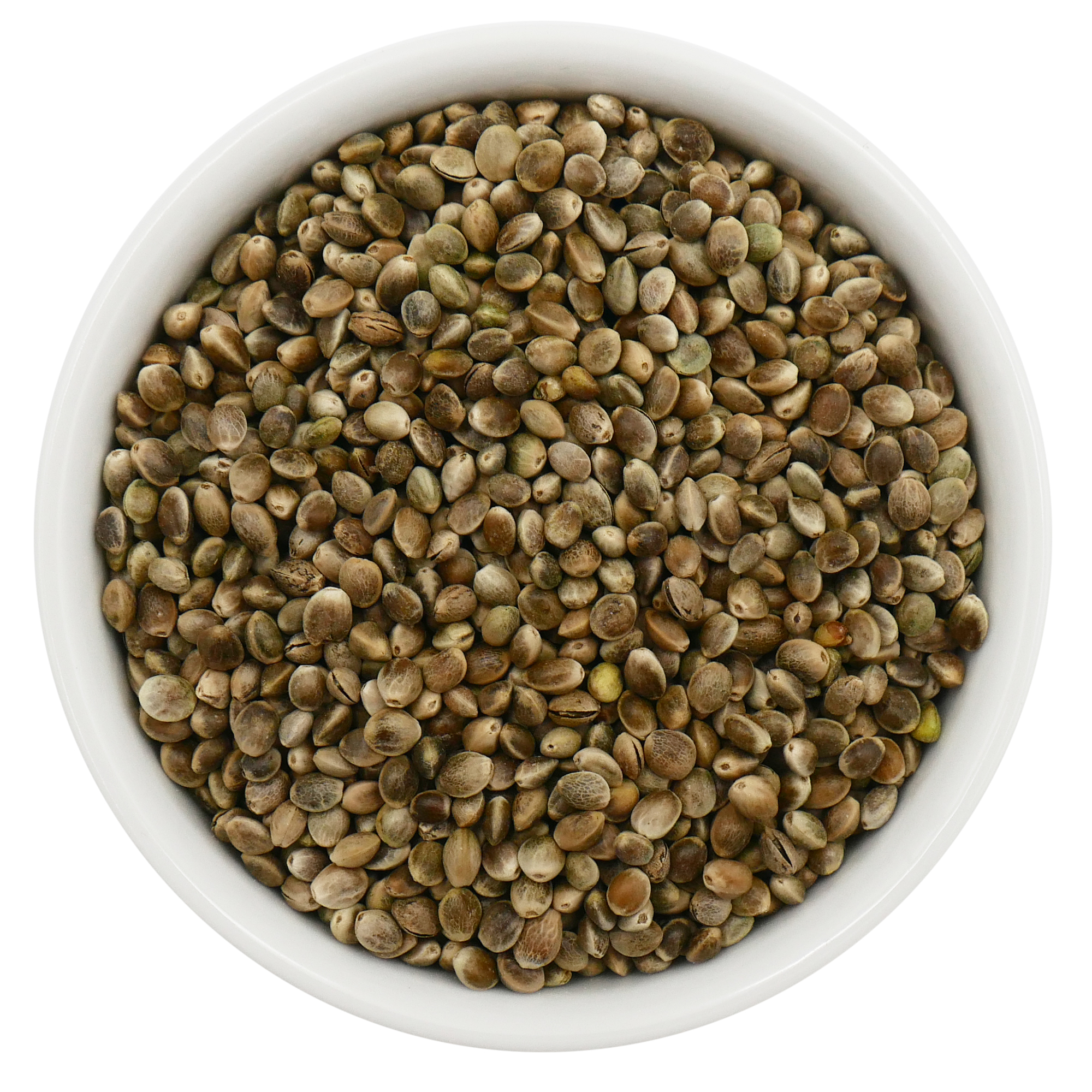
For seed production, the main criterion is the maturity of the seeds themselves.
The original material uses an approximate point at which around 70–80% of the seeds are mature.
Typical signs of maturity include:
- clear colour development,
- a hard outer shell,
- less susceptibility to damage under light pressure,
- noticeable drying of some parts of the flowers.
Harvesting too early results in a higher proportion of immature seeds, whereas waiting too long may increase the risk of natural seed shedding.
Most common mistakes when choosing harvest time
Harvesting only because a certain number of weeks has passed
The number of weeks is only an estimate. The plant may develop faster or slower depending on the conditions.
Judging maturity only by leaf colour
Yellowing can be natural, but it may also result from nutrient, root or watering problems.
Inspecting only one part of the plant
Maturation is often uneven. It is better to check several areas.
Following the lunar calendar blindly
The Moon phase can be an additional planning aid, but it should never be more important than plant maturity or deteriorating weather.
Ignoring the weather forecast
In outdoor cultivation, several days of rain near the end of the season may matter more than a few additional days of development.
Poor harvest preparation
Choosing the right day is not enough. It is worth preparing the necessary space, tools and workflow in advance so that the entire process can be carried out without unnecessary haste.
Quick checklist: is the plant ready?
- ✅ the estimated finishing time given by the producer has been reached,
- ✅ the plant is clearly in the final stage of its cycle,
- ✅ new growth has slowed significantly,
- ✅ several different areas of the plant have been inspected,
- ✅ the observed maturity indicators are consistent,
- ✅ the plant is healthy and there are no signs of a rapidly developing problem,
- ✅ the weather forecast is suitable,
- ✅ the plant is dry,
- ✅ the harvest space and logistics are prepared,
- ✅ the Moon phase is treated as an additional guideline rather than the main deciding factor.
If 7–8 points on this list clearly suggest that the plant is at the end of its cycle, it is worth carefully assessing the harvest window rather than relying on a single date from the calendar.
FAQ – frequently asked questions about harvest timing
The best time is when the plant has reached the expected maturity for its variety, the weather is suitable and the main maturity indicators observed across the whole plant confirm that it is in the final stage of its cycle. No. The producer's timing should be treated as a guideline. Environmental conditions and natural differences between individual plants can shift the actual finishing date. The timing should depend on the real condition and maturity of the plant. Simply approaching the stated number of weeks is not enough on its own to justify harvesting. They can be very useful, but they should be examined in several places and interpreted together with other signs of maturity. The upper section may develop differently from the middle and lower parts. Inspecting several areas gives a more representative picture of the whole plant. No. It may help you choose between several suitable dates, but plant maturity and weather conditions should always come first. In traditional gardening and biodynamic approaches, the waning Moon period, from the Full Moon to the New Moon, is often preferred. The Moon phase should not be more important than real-world conditions. If the plant is ready and the weather is favourable, the Full Moon itself is not a reason to delay the harvest unnecessarily. If possible, it is better to wait until the surface of the plant has dried. Wet plant material is more difficult to handle and more vulnerable to problems associated with excessive moisture. The most important thing is that the plant is dry. Early in the morning, dew can be an issue, so the actual moisture level of the plant is more important than a fixed time of day. For outdoor cultivation, the weather is more important. Prolonged rainfall, very high humidity and the risk of plant health problems can be much more significant than the exact Moon phase. Not always. Different sections may mature at different rates, especially on large outdoor plants, which is why several areas should be checked. Mature seeds are usually harder, better coloured and less susceptible to damage than immature seeds. For fibre production, harvesting usually takes place earlier than for many other uses, before the stems become heavily lignified. Not necessarily. Yellowing can be part of the natural end of the cycle, but it can also be caused by several other factors. The entire plant and several maturity indicators should be considered together. When is the best time to harvest plants?
Do I have to wait exactly as many weeks as the producer states?
Can plants be harvested earlier than the producer suggests?
Are trichomes a good maturity indicator?
Why should I not inspect only the main top?
Does the lunar calendar really determine the harvest date?
Which Moon phase is most commonly chosen for harvesting?
Can harvesting be carried out during a Full Moon?
Can plants be harvested after rain?
Morning or evening – when is outdoor harvesting better?
What is more important: the lunar calendar or the weather?
Do all parts of a large plant mature at the same time?
How can mature seeds be recognised?
When should plants intended for fibre be harvested?
Does natural yellowing of the leaves mean the plant must be harvested?
Summary – when is the right time to harvest?
The best harvest time is not determined by a single parameter. The most reliable decision comes from combining the variety's estimated finishing time, the actual maturity of the plant, observations from several areas of the plant and current weather conditions.
For outdoor cultivation, sensible reaction to the weather is especially important. If the plant is ready and several dry days are expected before a longer rainy period, that window may be more valuable than waiting for a theoretically perfect calendar date.
The lunar calendar is best treated as an additional planning tool. In 2026, the periods most often highlighted are those from the Full Moon to the New Moon, during the waning phase. They do not replace direct assessment of the plant.
The most important rule: observe the plant, not just the calendar. The producer's estimate tells you when to start looking more closely. The weather tells you when conditions are favourable. The lunar calendar can then help you choose the best day from several sensible options.