




Curing Dried Herbs – What Is It and How to Cure Them Properly?
05/31/2026 19:08:04 Poradniki
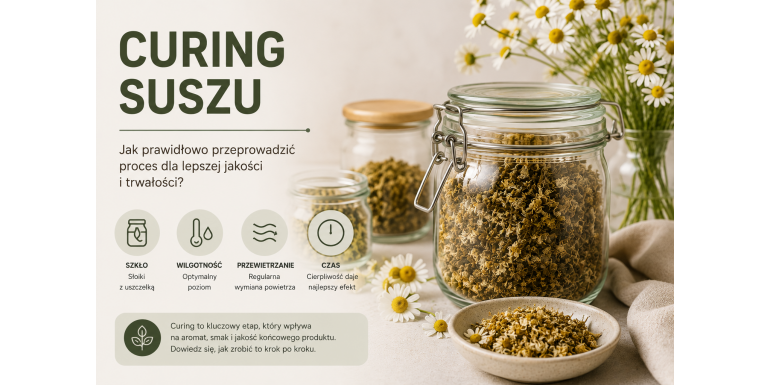
Curing Dried Herbs – What Is It and How to Do It Properly?
Drying is only the first stage of preparing dried plant material for longer storage. The second, often underestimated process is curing, which means controlled maturation of the material after drying. Curing has a major impact on aroma, freshness, stability, and the final quality of dried herbs.
Many people make the mistake of ending the process after drying alone. As a result, the material may be dried unevenly, lose its aroma faster, or fail to reach its full quality potential. Proper curing helps avoid these problems.
Table of Contents
- What is curing?
- Drying vs. curing – what is the difference?
- Why is curing important?
- How long does curing take?
- Ideal temperature and humidity
- Curing step by step
- Which containers should you choose?
- Most common mistakes
- Long-term storage
- Summary
- FAQ – frequently asked questions
1. What Is Curing?
Curing is the process of controlled maturation of dried plant material after the drying stage has been completed. It involves storing the material under suitable humidity and temperature conditions in order to gradually stabilize its structure and reduce excess moisture remaining inside the material.
During curing, natural processes take place that can improve the aroma and overall quality of the stored dried herbs. This process can be compared to the aging of tea or tobacco – time and stable conditions play a very important role.
2. Drying vs. Curing – What Is the Difference?
Drying
Drying is the process of removing most of the moisture from plant material. Its purpose is to reduce the risk of mold development and prepare the dried material for the next stage.
Curing
Curing begins only after drying has been completed. At this point, the goal is no longer to remove water quickly, but to allow controlled maturation and stabilization of the material.
In simple terms, drying prepares the material for storage, while curing affects its final quality.
3. Why Is Curing Important?
Skipping curing often results in average-quality dried material and faster loss of aroma during storage.
Proper curing can help:
- stabilize moisture levels,
- reduce the risk of overdrying,
- improve the aroma of the material,
- extend the shelf life of dried herbs,
- ensure more even maturation.
4. How Long Does Curing Take?
The length of the process depends on the type of material, the level of dryness, and the storage conditions.
- 1–2 weeks – basic stabilization,
- 3–4 weeks – noticeable quality improvement,
- 6–8 weeks – fuller curing and more stable material.
The most important factors are patience and regular control of storage conditions.
5. Ideal Temperature and Humidity
Stable environmental conditions are crucial during curing.
- temperature around 15–21°C,
- moderate relative humidity,
- no direct light exposure,
- a dark and stable storage place.
Excessively high temperatures may negatively affect aroma, while excessive humidity increases the risk of mold.
6. Curing Step by Step
1. Make sure drying is complete
The material should not be wet or excessively moist.
2. Place the dried material in containers
The containers should not be overfilled. It is worth leaving some free space inside.
3. Monitor the conditions
Regularly checking temperature and humidity helps prevent problems.
4. Allow air exchange
At the beginning of the process, some people periodically open the containers to balance the conditions inside.
5. Give the process time
Curing is a stage that should not be rushed.
7. Which Containers Should You Choose?
The most commonly used options include:
- glass jars,
- airtight storage containers,
- humidity control systems.
Glass containers are a popular choice because the material is neutral and convenient to use.
8. Most Common Mistakes
- Material that is too wet – increases the risk of mold.
- Drying too quickly – may reduce aroma quality.
- High temperature – negatively affects overall quality.
- Light exposure – may speed up material degradation.
- Lack of condition control – increases the risk of problems.
9. Long-Term Storage
After curing is complete, it is still important to maintain stable storage conditions. Dried herbs are best stored in a cool, dry, and dark place, away from major temperature fluctuations.
10. Summary
Curing is a process that often determines the final quality of dried plant material. Drying alone is not always enough – only controlled maturation allows the material to stabilize and improves its durability.
11. FAQ – Frequently Asked Questions
- Is curing necessary?
It is not always mandatory, but it often significantly improves the quality and stability of dried material. - How long does curing take?
Most often from several weeks up to two months. - Are curing and drying the same thing?
No. Drying removes most of the moisture, while curing is responsible for maturation and stabilization. - Which containers are best?
Airtight glass containers or humidity control systems are popular solutions. - Can curing go wrong?
Yes – most often because of excessive humidity, high temperature, or lack of condition control.
Legal Information
Note: This material is for informational and educational purposes only. The article presents general information about drying, curing, and storing plant material.
Regulations regarding the cultivation, possession, and processing of specific plant species may vary depending on the country and local legal regulations. Each user should independently check the laws applicable in their jurisdiction.
TanieUprawianie.pl does not promote or encourage any actions that are contrary to applicable law.