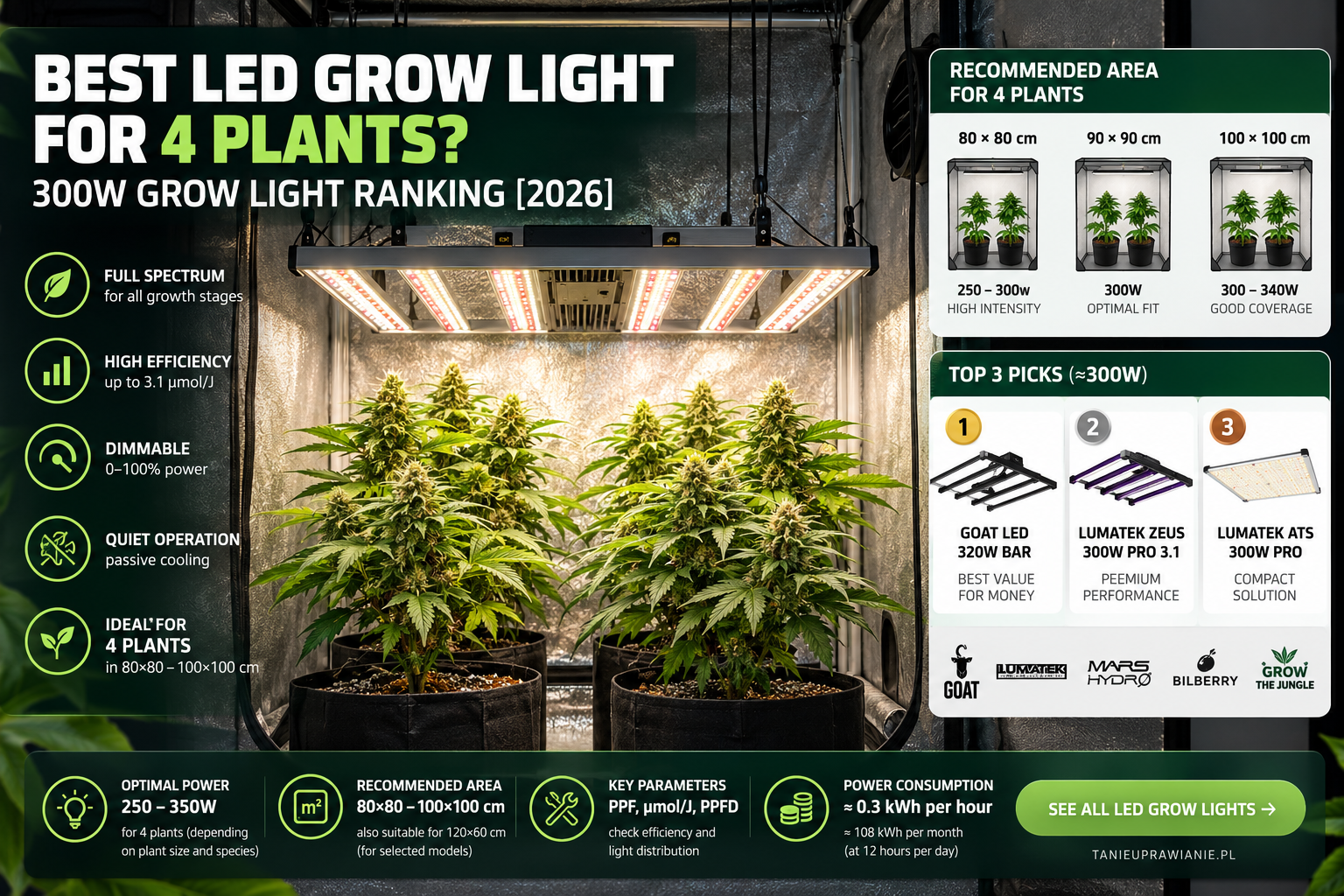




What LED Grow Light for 4 Plants? 300W LED Grow Light Ranking [2026]
07/10/2026 11:07:06 Poradniki , Informacje , Lighting for plants
![What LED Grow Light for 4 Plants? 300W LED Grow Light Ranking [2026]](https://tanieuprawianie.pl/blog/128-single-default/what-led-grow-light-for-4-plants-300w-led-gro.jpg)
What LED Grow Light for 4 Plants? 300W LED Grow Light Ranking [2026]
What LED grow light is suitable for 4 plants? In practice, the number of plants alone does not determine which grow light you need. The most important factors are the growing area, plant species, training method and the efficiency of the particular LED fixture. For areas of approximately 80 × 80, 90 × 90 or 100 × 100 cm, modern LED grow lights with an actual power consumption of around 250–350 W are often a very good option.
In this guide, we compare popular LED grow lights in the 300 W class and explain how to choose lighting for four plants and different growing areas. We consider power consumption, PPF, efficiency expressed in µmol/J, fixture design, light distribution, dimming and price.
Important: 4 plants do not always require the same grow light
Four small plants in a 60 × 60 cm area require completely different lighting than four large plants filling a 100 × 100 cm area. This is why an LED grow light should primarily be selected according to the growing area rather than simply the number of plants.
How many watts of LED light do you need for 4 plants?
There is no single wattage that is suitable for every setup with four plants. With modern LED grow lights, PPF, µmol/J efficiency and even PPFD distribution are often more useful than wattage alone.
For light-demanding plants covering approximately 80 × 80 to 100 × 100 cm, LED grow lights in the 250–350 W range are commonly considered. A modern and efficient 300–320 W fixture can deliver a considerable amount of light, so choosing a model with adjustable output is particularly useful.
For a smaller growing area, the full output of a 300 W fixture may not be necessary. For larger areas, the physical dimensions of the fixture and the uniformity of light at the edges become increasingly important.
What grow tent and growing area for 4 plants?
When choosing an LED grow light for four plants, first determine how much space the plants will actually occupy. The growing area should be the starting point when selecting your lighting.
| Growing area | Approx. 300W LED | Notes |
|---|---|---|
| 60 × 60 cm | usually excessive | Consider a lower-power fixture or significantly reduce the output with a dimmer. |
| 80 × 80 cm | high intensity | A good option for plants with high light requirements. |
| 90 × 90 cm | very good match | One of the most versatile areas for LED grow lights around 300 W. |
| 100 × 100 cm | good match | A wide fixture with good edge-to-edge light distribution is preferable. |
| 120 × 60 cm | excellent for selected models | Fixtures designed specifically for rectangular areas, such as the Lumatek Zeus, are particularly suitable. |
Conclusion: when asking “what LED grow light do I need for 4 plants?”, you should also consider the size of the growing area. Four plants can occupy anything from 60 × 60 cm to 100 × 100 cm or more, resulting in very different lighting requirements.
300W LED grow light ranking and comparison
The following models represent different approaches to lighting medium-sized growing areas. The comparison includes wide BAR-style fixtures, compact LED panels and models designed specifically for rectangular spaces.
| Model | Power | Design | Dimming | Key feature |
|---|---|---|---|---|
| GOAT LED 320W BAR | 320 W | BAR | 0–100% | Excellent performance-to-price ratio |
| Lumatek Zeus 300W PRO 3.1 | 312 W ±5% | BAR | Yes | High efficiency, designed for approx. 120 × 60 cm |
| Lumatek ATS 300W PRO | approx. 300 W | Panel | Yes | Compact design |
| Mars Hydro FC3000 | 300 W | BAR | Yes | Wide coverage and control options |
| Bilberry Grow Standard 340W | 340 W | Modular | Yes | Modular construction and serviceability |
| Grow The Jungle The Jackson LT | 250 W | Panel | Yes | Alternative for smaller growing areas |
Specifications may vary between product versions and generations. Always check the current product specifications before purchasing.
GOAT LED 320W BAR – a powerful option for around 4 plants
GOAT LED 320W BAR is a wide BAR-style LED grow light designed for intensive lighting of medium-sized growing areas. Its 320 W power consumption and 0–100% dimming allow the light intensity to be adjusted according to the plants' stage of development.
The use of multiple LED bars helps distribute light evenly and reduces the intense hotspot that can occur directly below the centre of a compact fixture. This is particularly useful when four plants occupy most of the available growing area.
The model uses Samsung 281B LEDs and a full spectrum including white, red, blue and far-red light.
Key features of the GOAT LED 320W
- 320 W power consumption,
- BAR-style construction,
- full spectrum,
- 0–100% dimming,
- passive and silent cooling,
- evenly distributed light sources,
- competitive price compared with many premium models.
Lumatek Zeus 300W PRO 3.1 – high-efficiency premium LED
Lumatek Zeus 300W PRO 3.1 is primarily designed for a rectangular growing area of approximately 120 × 60 cm. The manufacturer specifies an efficiency of 3.1 µmol/J and PPF of approximately 965 µmol/s at a power consumption of 312 W ±5%.
Its multi-bar construction provides wide and even light distribution. The fixture supports power adjustment and can work with external 0–10 V control systems.
Key features
- declared efficiency of 3.1 µmol/J,
- PPF of approximately 965 µmol/s,
- designed for approximately 120 × 60 cm,
- BAR-style construction,
- dimmable output,
- external control compatibility,
- premium product segment.
See Lumatek Zeus 300W PRO 3.1 →
Lumatek ATS 300W PRO – compact alternative
Lumatek ATS 300W PRO delivers approximately 300 W of power in a much more compact format than wide BAR fixtures. The manufacturer specifies a PPF of approximately 816 µmol/s and efficiency of up to 2.7 µmol/J.
The compact design can be an advantage where space is limited. On larger growing areas, however, particular attention should be paid to hanging height and light intensity around the edges.
Mars Hydro FC3000 – 300 W BAR-style grow light
Mars Hydro FC3000 is a popular 300 W BAR-style grow light. For current versions, the manufacturer specifies efficiency of up to approximately 2.85 µmol/J and PPF of around 855 µmol/s.
The spaced LED bars help distribute light across a wider area. Depending on the product version, the fixture may also be compatible with the manufacturer's control system.
Bilberry Grow Standard 340W
Bilberry Grow Standard 340W is a slightly more powerful option in this group. The fixture uses components from established manufacturers, while one of its notable advantages is its modular construction.
The ability to replace selected components may be particularly useful for growers planning long-term and intensive use of their lighting system.
Grow The Jungle The Jackson LT 250W
Grow The Jungle The Jackson LT 250W consumes less power than the other fixtures in this comparison and can be an interesting alternative where the full 300–340 W output is not required.
The model uses full-spectrum Samsung 282B+ LEDs together with additional 660 nm red LEDs. Lower power consumption also means less heat released into the growing space.
See Grow The Jungle LED grow lights →
What should you look for when choosing an LED grow light for 4 plants?
1. Growing area rather than plant count
This is the most important rule. Four plants can occupy very different amounts of space. Determine the dimensions of your growing area first and then choose a suitable fixture.
2. PPF
PPF indicates the total number of photons within the PAR range emitted by the fixture every second. It therefore provides more useful information about the light output than wattage alone.
3. PPFD map
PPFD shows how much light reaches a specific area. Do not look only at the highest value in the centre of the map. Uniformity across the entire growing area is equally important.
4. Efficiency in µmol/J
The µmol/J value indicates how efficiently the fixture converts electrical energy into photosynthetically useful light. A higher value means more useful light from the same amount of electricity.
5. Dimming
A dimmer is particularly useful with a grow light around 300 W. Young or smaller plants may not require full output, so adjustable power improves versatility and can reduce electricity consumption.
6. BAR fixture or compact panel?
BAR-style fixtures generally provide excellent light distribution and cooling. Compact panels require less space, but with larger growing areas it is especially important to check the difference between light intensity in the centre and around the edges.
How much electricity does a 300W LED grow light use?
A grow light drawing an actual 300 W consumes 0.3 kWh of electricity per hour.
- 10 hours per day – 3 kWh,
- 12 hours per day – 3.6 kWh,
- 14 hours per day – 4.2 kWh,
- 16 hours per day – 4.8 kWh.
At 12 hours per day for 30 days:
0.3 kW × 12 h × 30 days = 108 kWh per month.
The total running cost of the growing area should also include electricity consumed by ventilation, controllers, pumps, humidifiers and other equipment.
Which LED grow light should you choose for 4 plants?
If four plants occupy approximately 80 × 80 to 100 × 100 cm, modern LED grow lights in the 250–350 W class are worth comparing. Do not choose by wattage alone – check PPF, the PPFD map, efficiency, fixture dimensions and dimming capability.
FAQ – LED grow lights for 4 plants
How many watts of LED light do I need for 4 plants?
Power should not be selected solely according to the number of plants. For an area of approximately 80 × 80 to 100 × 100 cm, efficient LED grow lights in the 250–350 W range are commonly considered. A smaller growing area may require considerably less power.
Is a 300W LED enough for 4 plants?
On a suitably sized growing area, a modern LED grow light around 300 W can provide very intensive lighting for four plants. The actual requirements also depend on fixture efficiency, PPF, PPFD distribution and the requirements of the particular plant species.
What size grow tent is suitable for a 300W LED?
Many fixtures in this category work well with approximately 80 × 80, 90 × 90 or 100 × 100 cm growing areas. Some models, such as the Lumatek Zeus 300W PRO 3.1, are designed for a rectangular area of approximately 120 × 60 cm.
Is 300 W too much for an 80 × 80 cm grow tent?
It can provide very high light intensity, which is why a dimmer is particularly useful. Light intensity should be adjusted according to the plant species, age, hanging height and growing conditions.
What is more important – watts or PPF?
Wattage primarily tells you how much electricity the fixture consumes. PPF describes the amount of photosynthetically useful light it produces. For a meaningful comparison, consider PPF, µmol/J efficiency and the PPFD map together.
Is a BAR-style LED good for 4 plants?
Yes. Widely spaced LED bars can provide very even light distribution across the growing area, which is particularly useful when several plants are positioned next to each other.
Does a 300W LED grow light need a dimmer?
It is not essential, but dimming is very useful. It allows you to reduce light intensity for young plants, lower electricity consumption and use the same fixture throughout different stages of plant development.
How much does it cost to run a 300W LED?
At 12 hours of operation per day, a 300 W fixture consumes approximately 108 kWh per month. Multiply this figure by your total electricity price per kWh to calculate the running cost.
How high should I hang a 300W LED grow light?
There is no universal hanging height for every model. Follow the manufacturer's recommendations, adjust the dimmer where available and, for greater accuracy, use PPFD measurements.
Article updated: September 2026. Product specifications and availability may change between different generations and versions. Always check the current specifications of the particular grow light before purchasing.