




Jak oświetlać i ogrzewać szklarnię? Uprawa papryki i roślin ozdobnych pod lampami LED
11/27/2026 00:47:05 Poradniki , Lighting for plants
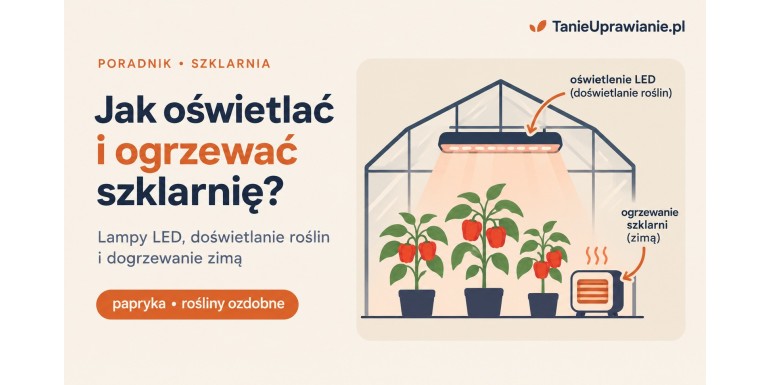
A greenhouse allows gardeners to extend the growing season, start seedlings earlier, grow vegetables and cultivate ornamental plants regardless of many adverse weather conditions. However, protection from wind and rain alone is not always enough. During autumn, winter and early spring, insufficient natural sunlight and low temperatures become the main challenges.
Modern LED grow lights help compensate for insufficient sunlight, support seedling development, encourage ornamental plant flowering and provide additional light for peppers and other fruiting vegetables. Combined with suitable heating, they make it possible to use a greenhouse more effectively outside the traditional growing season.
How should you light plants in a greenhouse? Which LED grow lights are suitable for peppers, geraniums, petunias and tomatoes? How much does supplemental lighting cost, and how can you heat a greenhouse during winter? This guide answers the most important questions.
Table of Contents
- Why do greenhouse plants need supplemental lighting?
- Which LED grow lights should you choose for a greenhouse?
- PPFD, PPF and DLI – essential lighting parameters
- Growing ornamental plants under greenhouse LED lights
- Growing peppers in a greenhouse – which LED lights to choose?
- Supplemental lighting for tomatoes, lettuce and other vegetables
- How to choose the right LED grow light wattage
- How long should greenhouse grow lights operate?
- How to heat a greenhouse in winter
- How to reduce greenhouse heat loss
- Greenhouse lighting and heating costs
- Common mistakes in year-round greenhouse growing
- Frequently asked questions
- Summary
1. Why Do Greenhouse Plants Need Supplemental Lighting?
Light is one of the fundamental factors influencing plant growth. Through photosynthesis, plants use light energy to produce organic compounds necessary for the development of leaves, roots, flowers and fruits.
In Poland and other parts of Central Europe, natural sunlight levels are significantly lower from late autumn to early spring than during summer. Greenhouse glass, polycarbonate panels and plastic coverings also reduce the amount of sunlight reaching plants.
Insufficient lighting can result in:
- Excessive stem elongation.
- Poor seedling development.
- Reduced growth rates.
- Delayed flowering.
- Reduced flower and fruit production.
- Lower quality of ornamental plants.
Good to know
Supplemental greenhouse lighting differs from growing plants entirely under artificial light. Greenhouse LED lights generally supplement natural sunlight, so their power and operating time should take into account the amount of daylight already reaching the plants.
2. Which LED Grow Lights Should You Choose for a Greenhouse?
Modern greenhouses increasingly use specialised horticultural LED lighting. Compared with older lighting technologies, LED grow lights can offer high energy efficiency, long service life and adjustable light intensity.
The most important features of suitable greenhouse lighting include:
- An appropriate light spectrum.
- High photosynthetic photon efficacy.
- Uniform light distribution.
- Adjustable light intensity.
- Suitability for greenhouse environmental conditions.
- A fixture design that minimises shading of natural sunlight.
Full Spectrum LED Grow Lights
Full Spectrum LED grow lights emit a broad range of wavelengths that plants can use for photosynthesis. They are a versatile solution for growing seedlings, vegetables, herbs and many ornamental plant species.
Another advantage is their more natural appearance compared with traditional red and blue grow lights. This makes it easier to observe plant health, leaf colour, flowers and possible nutrient deficiency symptoms.
LED Panels and Bar-Style Grow Lights
Compact LED panels can be suitable for individual growing benches or designated groups of plants. Bar-style fixtures allow light sources to be distributed across larger growing areas.
When selecting a grow light, consider not only its wattage but also its PPFD distribution map, dimensions, installation requirements and recommended operating conditions.
LED Grow Lights Available at TanieUprawianie.pl
Our store offers grow lights with different power ratings and designs for home gardening and professional horticultural applications.
3. PPFD, PPF and DLI – Essential Lighting Parameters
When choosing greenhouse grow lights, electrical wattage should not be the only consideration. Power consumption tells you how much electricity a fixture uses, but it does not directly indicate how much useful light reaches the plants.
| Parameter | What Does It Mean? |
|---|---|
| PPF | Photosynthetic Photon Flux – the total number of photosynthetic photons emitted by a light source per second, expressed in µmol/s. |
| PPFD | Photosynthetic Photon Flux Density – the amount of photosynthetic light reaching a given surface per second, expressed in µmol/m²/s. |
| PPE | Photosynthetic Photon Efficacy – the efficiency of a grow light, expressed in µmol/J. |
| DLI | Daily Light Integral – the total amount of photosynthetic light received by plants throughout the day, expressed in mol/m²/day. |
| Wattage (W) | The nominal electrical power consumption of a lighting fixture. |
Why Is DLI Particularly Important in Greenhouses?
Greenhouse plants receive light from both the sun and artificial lighting. Daily Light Integral makes it possible to assess the total amount of photosynthetic light received from both sources throughout the day.
This provides a better understanding of plant lighting requirements than relying solely on daylight duration or installed lighting wattage.
What Is the Difference Between Lux and PPFD?
Lux measures light according to the sensitivity of the human eye. PPFD measures photons within the photosynthetically active radiation range, making it a more useful parameter when evaluating specialised horticultural lighting.
4. Growing Ornamental Plants Under Greenhouse LED Lights
Greenhouses are not limited to vegetable production. They also provide an excellent environment for propagating, maintaining and producing ornamental plants, particularly those intended for spring sales or planting on balconies and terraces.
LED lighting can support the cultivation of ornamental plants such as:
- Geraniums and pelargoniums.
- Petunias and surfinias.
- Begonias.
- Impatiens.
- Pansies.
- Chrysanthemums.
- Decorative foliage plants.
- Young perennial and garden plants.
Supplemental Lighting for Seedlings and Young Ornamental Plants
Seedling production often begins when natural sunlight is limited. Insufficient lighting can lead to elongated stems and uneven plant development.
LED grow lights installed above growing benches can supplement natural sunlight. Uniform light distribution is particularly important because plants located at the edges of a growing area should receive conditions comparable to those in the centre.
Lighting for Flowering Ornamental Plants
For ornamental plants, both the total amount of light and the duration of day and night can be important. Certain species respond to specific day lengths, which can influence flowering time.
Professional ornamental horticulture therefore distinguishes between photosynthetic lighting, which increases the daily amount of light, and photoperiodic lighting, which is used to regulate perceived day length.
Consider Species-Specific Lighting Requirements
Geraniums, begonias and chrysanthemums do not necessarily have identical lighting requirements. Excessively long lighting periods may interfere with flowering in photoperiod-sensitive species. Lighting schedules should therefore be adapted to the individual plant species.
5. Growing Peppers in a Greenhouse – Which LED Lights to Choose?
Peppers are warmth-loving vegetables, making greenhouses particularly suitable for their cultivation. A protected growing environment reduces exposure to adverse weather conditions and allows gardeners to extend the production season.
However, growing peppers under cover may require supplemental lighting, especially when preparing seedlings during winter and early spring.
LED Lighting for Pepper Seedlings
Young pepper plants require sufficient light to support healthy leaf and stem development. Under poor lighting conditions, seedlings may become excessively elongated, fragile and less suitable for later transplanting.
Full Spectrum LED grow lights with adjustable power can be used above seedling benches. Adjustable intensity makes it possible to adapt lighting to the plants' development stage and the amount of natural sunlight available inside the greenhouse.
Supplemental Lighting During Pepper Flowering and Fruiting
Mature pepper plants require adequate light to develop flowers and fruits. The amount of available sunlight inside a greenhouse depends on the season, cloud cover, greenhouse covering material and the location of the growing area.
During summer, supplemental lighting may not always be necessary. It can become more relevant during extended autumn production or prolonged periods of cloudy weather.
What Should You Consider When Choosing LED Grow Lights for Peppers?
- A light spectrum suitable for horticulture.
- Uniform light distribution across the growing area.
- Adjustable light intensity.
- High energy efficiency.
- Fixture dimensions and mounting options.
- Suitability for greenhouse operating conditions.
Looking for LED Grow Lights for Peppers and Other Vegetables?
Explore our range of GOAT LED grow lights and other horticultural lighting brands. Individual models differ in wattage, design and efficiency, allowing you to select equipment appropriate for your growing area.
6. Supplemental Lighting for Tomatoes, Lettuce and Other Vegetables
Not all vegetables have identical lighting and temperature requirements. Fruiting vegetables such as tomatoes, peppers and cucumbers generally require more light than many leafy vegetables.
| Plant | Light Requirements | Growing Characteristics |
|---|---|---|
| Peppers | High | Warmth-loving, fruit-producing plants. |
| Tomatoes | High | Light availability is particularly important during fruit production. |
| Cucumbers | High | Rapid growth and large leaf surfaces. |
| Lettuce | Moderate | Leafy vegetable frequently grown outside the main growing season. |
| Herbs | Species-dependent | Different lighting and temperature requirements. |
| Ornamental Plants | Species-dependent | Day length may also influence flowering. |
This comparison is provided for general guidance. Actual plant requirements depend on the variety, development stage and other environmental conditions.
7. How to Choose the Right LED Grow Light Wattage
One of the most frequently asked questions is how many watts of LED lighting are required per square metre of greenhouse space. However, there is no universal wattage recommendation suitable for every greenhouse.
A greenhouse measuring 10 m² does not necessarily require lighting across its entire floor area. If plants are located on several growing benches, illuminating only those areas may be more economical.
When selecting greenhouse lighting, consider:
- The actual surface area occupied by plants.
- The mounting height of the lighting fixtures.
- The amount of available natural sunlight.
- The lighting requirements of the cultivated species.
- The efficacy and light distribution of individual fixtures.
- The possibility of creating independent lighting zones.
Does Higher Wattage Always Mean Better Lighting?
No. Two LED fixtures with identical electricity consumption can produce different amounts of useful light. LED quality, drivers, operating temperature, overall fixture efficacy and light distribution all play an important role.
For more information about selecting greenhouse lighting equipment, read our related article: Supplemental Greenhouse Lighting – How to Choose the Right Grow Lights.
8. How Long Should Greenhouse Grow Lights Operate?
The operating time of grow lights should take into account natural daylight duration, sunlight availability and the requirements of individual plant species. Supplemental lighting may be needed more frequently during autumn and winter than during spring and summer.
Timers and lighting controllers can be used to automate grow light operation. More advanced greenhouse installations may also use light sensors that respond to changing sunlight conditions.
These solutions help reduce unnecessary electricity consumption during sunny periods and support more consistent growing conditions.
More Light Does Not Always Mean Better Results
Not all plants tolerate excessively long lighting periods. Their natural day-night rhythm, flowering requirements and response to light intensity should be taken into consideration.
9. How to Heat a Greenhouse in Winter
LED lighting alone does not solve all the challenges associated with year-round greenhouse cultivation. In colder climates, maintaining suitable temperatures is equally important.
During freezing nights, temperatures inside an unheated greenhouse can drop significantly. Young plants, warmth-loving vegetables and certain ornamental species are particularly sensitive to cold conditions.
Greenhouse Tube Heaters
Tube heaters are simple electrical heating devices designed to release heat without using an integrated fan. They can provide supplemental heating in appropriately prepared horticultural spaces.
Our store offers several models with different power ratings:
| Heater Model | Power | Design |
|---|---|---|
| 55 W Tube Heater | 55 W | Tubular, 50 cm |
| 90 W Tube Heater | 90 W | Tubular, 70 cm |
| 135 W Tube Heater | 135 W | Tubular |
| ECOHEAT 135 W | 135 W | Tubular, 96.5 cm |
| ECOHEAT 240 W | 240 W | Tubular, 126.5 cm |
Can a Small Heater Warm an Entire Greenhouse?
Low-wattage tube heaters should primarily be considered supplemental heat sources. During severe winter conditions, heating an entire greenhouse may require significantly more powerful equipment selected according to actual heat loss.
Greenhouse Fan Heaters
Specialised greenhouse fan heaters provide an alternative to tube heaters. They circulate heated air and are available in higher-power versions.
These devices require a suitable electrical installation. Before purchasing, check whether the specific heater is designed to operate in environments with elevated humidity.
Thermostats and Temperature Control
Automatic heating control can help reduce unnecessary energy consumption. However, it is important to distinguish between thermostats that regulate the heating element and controllers that measure the actual ambient air temperature.
Not every heater equipped with an adjustment dial can accurately maintain a selected greenhouse air temperature.
10. How to Reduce Greenhouse Heat Loss
Heating a greenhouse during winter can result in considerable electricity costs, particularly when the structure has poor thermal insulation. Before purchasing a more powerful heater, consider whether unnecessary heat loss can be reduced.
Common greenhouse insulation solutions include:
- Sealing uncontrolled gaps in the greenhouse structure.
- Using thermal insulation materials designed for greenhouses.
- Installing multiwall polycarbonate panels.
- Using thermal screens and curtains.
- Creating a smaller designated overwintering area.
- Avoiding unnecessary door opening during freezing weather.
Reducing heat loss should not mean eliminating ventilation entirely. Excessive humidity and condensation can encourage plant diseases and create risks for electrical installations.
Lighting and Insulation Must Work Together
Thermal insulation materials may reduce the amount of natural sunlight reaching plants. Choose products specifically designed for greenhouse applications and consider their effect on sunlight transmission.
11. Greenhouse Lighting and Heating Costs
The operating costs of LED grow lights and electric greenhouse heaters depend primarily on their electrical power consumption, actual operating time and local electricity prices.
Electricity costs can be calculated using a simple formula:
Power in kW × Operating Hours × Electricity Price per kWh
The following table presents example monthly operating costs based on an electricity price of PLN 1.20 per kWh and 30 operating days per month.
| Equipment | Daily Operating Time | Monthly Consumption | Monthly Cost |
|---|---|---|---|
| 100 W LED Grow Light | 8 hours | 24 kWh | PLN 28.80 |
| 150 W LED Grow Light | 8 hours | 36 kWh | PLN 43.20 |
| 300 W LED Grow Light | 8 hours | 72 kWh | PLN 86.40 |
| 90 W Heater | 12 hours | 32.4 kWh | PLN 38.88 |
| 135 W Heater | 12 hours | 48.6 kWh | PLN 58.32 |
| 240 W Heater | 12 hours | 86.4 kWh | PLN 103.68 |
| 2000 W Heater | 12 hours | 720 kWh | PLN 864.00 |
These figures are illustrative calculations based on operation at full nominal power. They are not recommended operating schedules or predictions of actual greenhouse heating costs. Electricity prices vary by country, region and energy supplier.
12. Common Mistakes in Year-Round Greenhouse Growing
Choosing Grow Lights Based Only on Wattage
Electrical wattage alone does not determine lighting quality. Fixture efficacy, construction and light distribution should also be considered.
Lighting Unoccupied Areas
Illuminating empty walkways, walls and unused greenhouse areas results in unnecessary electricity consumption.
Using LED Grow Lights as the Primary Heating System
LED grow lights generate heat during operation, but they are not designed to provide controlled greenhouse heating. Lighting and heating systems should be considered separately.
Ignoring Species-Specific Lighting Requirements
Ornamental plants, vegetable seedlings and mature fruiting plants have different requirements. A universal lighting schedule may not be suitable for every species.
Ignoring Greenhouse Humidity
High humidity and water condensation can affect plant health and the safety of electrical equipment.
Electrical Safety in Greenhouses
Not every LED grow light designed for indoor horticulture is suitable for greenhouse installation. Before purchasing, check the IP protection rating, permitted humidity levels, operating temperature range and manufacturer's instructions.
Electrical installations should include appropriate safety protection. Cables and connections must be protected against moisture and mechanical damage. For larger installations, consult a qualified electrician.
13. Frequently Asked Questions – Greenhouse Lighting and Heating
What Are the Best Grow Lights for a Greenhouse?
Specialised horticultural LED grow lights with suitable light efficacy, spectrum and uniform light distribution are a good option. The selected fixtures must also be suitable for the environmental conditions inside the greenhouse.
Which LED Grow Lights Should I Use for Peppers?
Full Spectrum LED grow lights with adjustable power are worth considering. The most suitable model depends on the growing area, available natural sunlight and the development stage of the pepper plants.
Are LED Grow Lights Suitable for Ornamental Plants?
Yes. LED grow lights are used for seedling production, plant propagation and supplemental lighting for many ornamental species. Lighting intensity and photoperiod requirements should be adapted to individual plant species.
How Many Watts of LED Lighting Do I Need per Square Metre of Greenhouse Space?
There is no universal wattage recommendation. Lighting requirements depend on natural sunlight availability, actual growing area, fixture efficacy and the requirements of the cultivated plants.
Can Regular LED Bulbs Be Used as Grow Lights?
Regular LED bulbs emit light that plants can partially use. However, specialised horticultural LED grow lights are designed with plant lighting requirements, photosynthetic photon efficacy and growing-area light distribution in mind.
How Can I Heat a Greenhouse During Winter?
Suitable options include specialised electric greenhouse heaters, tube heaters and greenhouse fan heaters. Heating power must be selected according to heat loss, greenhouse size and outdoor temperatures.
Is a Tube Heater Powerful Enough to Heat an Entire Greenhouse?
A tube heater can provide supplemental heating. Its ability to heat an entire greenhouse depends on the structure's insulation, size, outdoor weather conditions and heater power.
Do LED Grow Lights Heat a Greenhouse?
LED grow lights generate heat during operation, but their primary function is providing light. They should not replace a properly designed greenhouse heating system.
Can Peppers Be Grown in a Greenhouse All Year Round?
Year-round pepper cultivation is possible in a properly equipped greenhouse. Suitable lighting, temperatures and other environmental conditions must be maintained. In colder climates, winter production can involve considerable energy costs.
Can Any LED Grow Light Be Installed in a Greenhouse?
No. Before installation, check the IP protection rating, permitted humidity levels, operating temperatures and manufacturer's instructions. Moisture and condensation can damage equipment that is not designed for greenhouse conditions.
14. Summary – Greenhouse Lighting and Heating All Year Round
Suitable greenhouse equipment can significantly expand the possibilities of home gardening and professional horticulture. Specialised LED grow lights provide supplemental lighting for seedlings, ornamental plants and vegetables such as peppers, tomatoes and cucumbers.
During winter, heating, reducing heat loss and safely monitoring environmental conditions are equally important.
When choosing greenhouse equipment, consider the actual requirements of your plants, technical equipment specifications and long-term operating costs.
Equip Your Greenhouse with TanieUprawianie.pl
Discover our range of specialised horticultural LED grow lights, tube heaters, environmental control accessories and equipment for growing ornamental plants and vegetables.
Need help choosing the right lighting equipment? Contact us and tell us about your greenhouse, growing area and the types of plants you intend to cultivate.
Sources and Further Reading
- University of Missouri Extension – Understanding Grow Lights
- Purdue University – Measuring Daily Light Integral in a Greenhouse
- Washington State University – Greenhouse Construction and Management
TanieUprawianie.pl Editorial Team