




Advanced Hydroponics of Holland Tabela Dawkowania
10/10/2024 22:19:16 Feeding Schedule

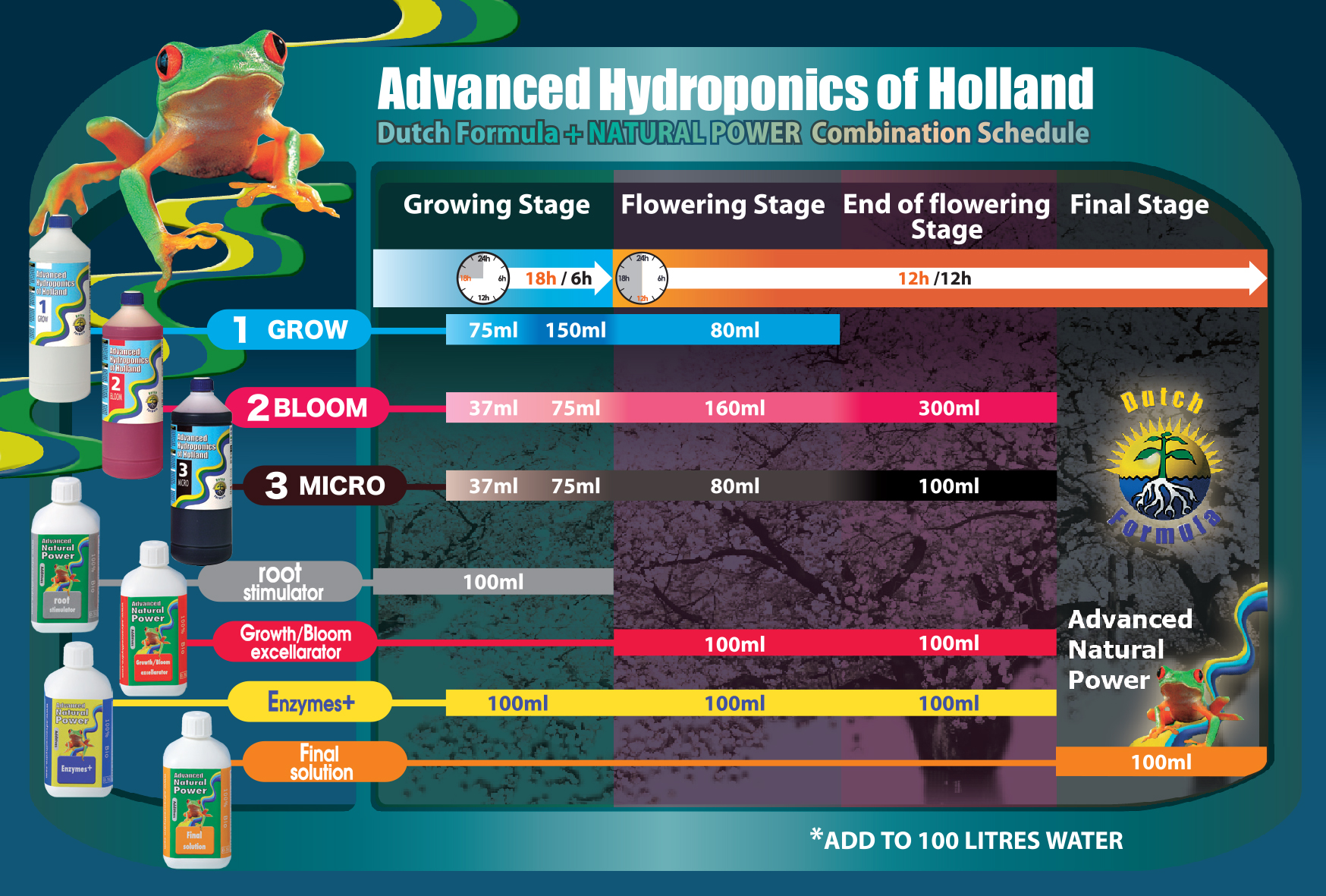
Advanced Hydroponics of Holland feeding chart shows how to use Dutch Formula Grow, Bloom and Micro together with the manufacturer's additional supplements throughout the plant life cycle. The system allows the nutrient ratio to be adjusted depending on the growth stage – from vegetative growth through flowering and into the final phase.
Important: the values shown in the Advanced Hydroponics feeding chart are given in ml per 1 litre of water. After preparing the nutrient solution, the recommended pH range is approximately 5.8–6.2. When growing in soil, it is advisable to start with a lower nutrient concentration than in inert substrates or hydroponic systems.
Contents
- How to read the Advanced Hydroponics feeding chart
- Dutch Formula Grow, Bloom and Micro – how it works
- Advanced Hydroponics dosage week by week
- Dosage during the vegetative stage
- Dosage during flowering
- Root Stimulator, Enzymes+, Growth/Bloom Excellarator and Final Solution
- How to mix Advanced Hydroponics nutrients
- pH and EC
- Soil, coco and hydroponics
- Common feeding mistakes
- FAQ
How to read the Advanced Hydroponics feeding chart
The Advanced Hydroponics of Holland feeding schedule is divided into individual weeks and plant development stages. Each product is assigned a specific quantity, usually expressed in millilitres per litre of water.
The chart should be treated as a practical reference rather than an absolute rule. Actual nutrient requirements may vary depending on:
- plant species and variety,
- age and size of the root system,
- type of growing medium,
- water hardness and mineral content,
- starting EC of the water,
- temperature and humidity,
- light intensity,
- watering frequency.
When using a nutrient programme for the first time, it is usually safer to begin with a moderate concentration and observe how the plants respond before increasing the dose.
Dutch Formula Grow, Bloom and Micro – how does it work?
The core of the Advanced Hydroponics feeding programme is the Dutch Formula, consisting of three mineral nutrients:
- Grow – mainly used during vegetative growth,
- Bloom – its proportion increases during flowering,
- Micro – provides essential micronutrients and is used through a large part of the cycle.
Grow, Bloom and Micro are designed to work together as a three-part nutrient system. They are not simply three independent fertilisers. Their proportions change according to the plant's stage of development.
During vegetative growth, Grow has a larger share. As flowering begins, the amount of Bloom increases, while Grow is gradually reduced and eventually removed from the programme.
Advanced Hydroponics dosage week by week
The following values provide a simple overview of the Dutch Formula feeding concept. Always compare them with the manufacturer's feeding chart shown above before preparing the final nutrient solution.
| Stage | Grow | Bloom | Micro |
|---|---|---|---|
| Vegetative week 1 | 1 ml/L | 0.5 ml/L | 0.5 ml/L |
| Vegetative weeks 2–3 | 2 ml/L | 1 ml/L | 1 ml/L |
| Early flowering | 1 ml/L | 2 ml/L | 1 ml/L |
| Full flowering | 0 ml/L | up to 3 ml/L | 1 ml/L |
| Late flowering | 0 ml/L | approx. 1.5 ml/L | approx. 0.5 ml/L |
| Final stage | 0 | 0 | 0 |
Example: if the chart recommends 2 ml/L, use 10 ml for 5 litres of water or 20 ml for 10 litres. A dosage of 0.5 ml/L equals 5 ml per 10 litres of water.
Advanced Hydroponics dosage during the vegetative stage
During vegetative growth, plants focus primarily on producing roots, stems and leaves. For this reason, the nutrient ratio is shifted towards Grow.
The nutrient concentration is usually lower at the beginning of the cycle. It can then be increased gradually, provided that the plants remain healthy and the EC of the solution does not rise excessively.
Root Stimulator may also be used during this stage to support the development of the root zone.
Advanced Hydroponics dosage during flowering
When flowering begins, the nutrient ratio changes. The amount of Grow decreases while the proportion of Bloom increases.
A typical early flowering ratio is approximately:
- 1 ml/L Grow,
- 2 ml/L Bloom,
- 1 ml/L Micro.
During the later stages of flowering, Grow is removed completely and Bloom becomes the main component of the base nutrient programme together with Micro.
However, nutrient strength should not be increased automatically just because the plant has moved into the next week of the chart. Always take the actual EC and condition of the plant into account.
Advanced Hydroponics supplements
Root Stimulator
Root Stimulator is mainly used during the early stages of plant development and is designed to support root growth and establishment.
Enzymes+
Enzymes+ is used through a large part of the cultivation cycle and helps support the root-zone environment.
Growth/Bloom Excellarator
Growth/Bloom Excellarator is an additional supplement used alongside Dutch Formula. It does not replace Grow, Bloom or Micro.
Final Solution
Final Solution is included in the final part of the feeding programme and is intended for use during the closing stage of the cycle.
How to mix Advanced Hydroponics Grow, Bloom and Micro
Concentrated nutrients should not be mixed directly together. Each component should be added separately to water and thoroughly mixed before the next product is added.
A practical mixing sequence is:
- fill the reservoir with the required amount of water,
- add the first Dutch Formula component and mix thoroughly,
- add the next component and mix again,
- add Micro and any supplements required for the current stage,
- mix the complete nutrient solution thoroughly,
- measure EC,
- measure and adjust pH if required.
Important: never pour concentrated Grow, Bloom and Micro directly into each other. Always dilute each product in water separately.
What pH should be used with Advanced Hydroponics?
The recommended nutrient solution range is approximately pH 5.8–6.2.
It is best to measure and adjust pH only after all nutrients have been added, because fertilisers can change the pH of the water.
Why is EC important?
Dosage in ml/L does not show the total concentration of dissolved mineral salts in the nutrient solution. The final EC also depends on the quality and mineral content of the source water.
For example, hard water with a relatively high starting EC can produce a much stronger final nutrient solution than soft water even when the same amount of fertiliser is added.
For this reason, good practice is to use:
- the manufacturer's feeding chart,
- an EC meter,
- a pH meter,
- visual observation of plant condition.
Advanced Hydroponics in soil, coco and hydroponics
Dutch Formula can be used in several growing systems, including:
- soil,
- coco coir,
- rockwool,
- hydroponic systems,
- other inert growing media.
Advanced Hydroponics dosage in soil
Soil can already contain a significant amount of nutrients, especially when using pre-fertilised substrates. For this reason, it is usually advisable to begin with a lower concentration than the full hydroponic feeding rate.
Advanced Hydroponics dosage in coco
Coco is far less nutrient-rich than most fertilised soils. The nutrient programme can therefore be used closer to the recommendations for inert substrates, while monitoring EC of both the nutrient solution and runoff.
Advanced Hydroponics in hydroponics
In hydroponic cultivation, plants have direct access to the nutrient solution. Regular monitoring of EC and pH is therefore especially important, not only when the tank is prepared but also during use.
Common mistakes when using Advanced Hydroponics
1. Starting immediately with the maximum dose
Young or recently transplanted plants may require a weaker nutrient solution. The feeding chart should be treated as a guide rather than an obligation to use the maximum concentration.
2. Ignoring EC
Two growers using the same 2 ml/L dosage may still end up with very different nutrient strengths if their source water has different mineral content.
3. Adjusting pH before adding nutrients
Prepare the complete nutrient solution first and adjust pH afterwards.
4. Mixing nutrient concentrates together
Grow, Bloom and Micro should always be diluted separately in water.
5. Using the same strength in soil and hydroponics
Pre-fertilised soil may already supply many nutrients, so full hydroponic rates can be too strong.
6. Increasing dosage despite signs of overfeeding
Burnt leaf tips, unusually high EC or visible deterioration after increasing the dose are signs that nutrient strength may need to be reduced.
How to calculate Advanced Hydroponics dosage
- 0.5 ml/L = 5 ml per 10 L of water,
- 1 ml/L = 10 ml per 10 L of water,
- 1.5 ml/L = 15 ml per 10 L of water,
- 2 ml/L = 20 ml per 10 L of water,
- 3 ml/L = 30 ml per 10 L of water.
For small quantities, a syringe or measuring cup with a precise scale makes dosing much easier.
FAQ – Advanced Hydroponics feeding chart
Grow, Bloom and Micro are used together as a three-part Dutch Formula nutrient system. Their proportions change according to the plant's stage of development. Grow is dominant during vegetative growth, while Bloom becomes more important during flowering. The dosage depends on the product and growth stage. Values in the feeding chart commonly range from approximately 0.5 to 3 ml per litre of water. Multiply the ml/L value by 10. For example, 1 ml/L equals 10 ml per 10 litres, 2 ml/L equals 20 ml and 3 ml/L equals 30 ml. Yes. Dutch Formula is a three-part nutrient system and the proportions of Grow, Bloom and Micro change throughout the plant cycle. No. The concentrated products should not be mixed directly with one another. Add each nutrient separately to water and mix thoroughly before adding the next one. A nutrient solution around pH 5.8–6.2 is commonly recommended. Always measure pH after all nutrients have been added. Yes. Dutch Formula can be used in soil, but lower nutrient strength is usually advisable because soil may already contain plant nutrients. Yes. Dutch Formula is suitable for coco coir. Monitoring the EC of the nutrient solution and runoff can help prevent both underfeeding and excessive salt build-up. Yes. Dutch Formula is designed for use in hydroponics and other inert growing media. Regular EC and pH control is particularly important in these systems. Grow is gradually reduced after flowering begins and is removed from the programme during the later flowering stage, while Bloom and Micro continue for longer. Burnt leaf tips may indicate an overly strong nutrient solution. Check EC, pH and the starting EC of your water and reduce nutrient concentration if necessary. The chart is a reference point. Nutrient requirements can vary depending on genetics, growing medium, water quality, climate, light intensity and plant condition. How do I dose Advanced Hydroponics Grow, Bloom and Micro?
How much Advanced Hydroponics should I use per litre of water?
How much Advanced Hydroponics should I use for 10 litres of water?
Do I use Grow, Bloom and Micro together?
Can I mix Grow, Bloom and Micro concentrates together?
What pH should I use with Advanced Hydroponics?
Can Advanced Hydroponics be used in soil?
Can Advanced Hydroponics be used in coco?
Is Advanced Hydroponics suitable for hydroponic systems?
When should I stop using Grow?
What should I do if leaf tips start burning?
Is the Advanced Hydroponics feeding chart suitable for every plant?
Advanced Hydroponics feeding chart – summary
The Advanced Hydroponics of Holland feeding chart provides a clear framework for using Dutch Formula Grow, Bloom and Micro throughout the plant cycle.
Grow is used more heavily during vegetative development, while Bloom becomes increasingly important during flowering. Micro supplies essential micronutrients throughout a large part of the feeding programme.
For the best results, do not rely solely on ml/L values. Always take into account EC, pH, water quality, growing medium and the actual condition of the plants. This makes it much easier to adapt the Advanced Hydroponics dosage to real growing conditions.