




Expanded Clay in Gardening – What Is It, What Is It Used For and How to Use It?
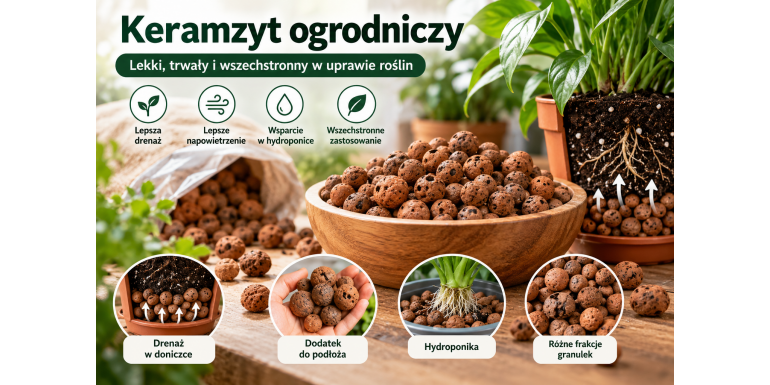
Expanded clay for gardening is a lightweight, durable and porous ceramic aggregate with many uses in plant cultivation. It is most commonly used as a drainage layer in pots, as an additive that improves substrate structure and as a growing medium in hydroponic systems.
Expanded clay can help improve water and air conditions around the root zone, and thanks to its durability it can be used for a long time. In this guide, we explain what expanded clay is, what it is used for, which grain size to choose and how it differs from perlite.
What is expanded clay?
Expanded clay is produced by firing specially prepared clay at high temperatures. During this process, the material expands and develops its characteristic porous structure.
The finished material usually comes in the form of lightweight, hard pellets or granules of different sizes. It is resistant to moisture, relatively light and does not break down quickly.
It is important to remember that expanded clay is not a fertilizer. Its main purpose is not to provide nutrients, but to improve the physical properties of the growing medium.
What is expanded clay used for?
Expanded clay is a very versatile material. It can be used:
- as a drainage layer at the bottom of plant pots,
- as an additive to soil and substrate mixes,
- to improve aeration of the growing medium,
- in hydroponic systems,
- to fill large pots and containers,
- as a decorative layer on top of the substrate.
One of its biggest advantages is durability. Unlike many organic materials, expanded clay does not decompose quickly and keeps its structure for a long time.
Expanded clay as drainage in plant pots
One of the most common uses of expanded clay is as a drainage layer at the bottom of a pot. The granules create additional space between the soil and the base of the container.
This can be especially useful in larger pots and in situations where excess water should be able to drain away efficiently.
However, expanded clay does not replace proper drainage holes. If the pot has no way of releasing excess water, an expanded clay layer alone will not solve the problem of waterlogging.
How much expanded clay should be placed at the bottom of a pot?
There is no single ideal thickness for every container. In smaller pots, a relatively thin layer is usually enough, while larger containers may benefit from a thicker layer.
The amount should be adjusted to the size of the pot, the type of substrate and the needs of the plant.
Can expanded clay be mixed with soil?
Yes. Expanded clay can also be used as a substrate additive. Larger granules create additional air spaces in the soil and may help reduce excessive compaction of heavy mixes.
In dense, heavy substrates, it can help improve structure. However, it is not always the best option when very fine and even loosening of the entire mix is required.
If the main goal is to make the substrate lighter and looser, perlite is also commonly used.
Expanded clay in hydroponics
Expanded clay is a very popular medium in hydroponics and other soilless growing systems. Roots can develop between the pellets while the porous structure helps maintain good air space.
For hydroponic use, expanded clay with a relatively even grain size is usually preferred. Before first use, it is worth rinsing the granules thoroughly, as dust may be present after production and transport.
If you are interested in soilless growing, see our range of hydroponic substrates.
Which expanded clay grain size should you choose?
Expanded clay is available in different grain sizes. The right choice depends mainly on how the material will be used.
- Fine expanded clay – suitable for smaller pots and as part of substrate mixes.
- Medium grain size – a versatile option for drainage and general gardening use.
- Coarse expanded clay – useful in larger containers and many hydroponic systems.
A popular option is expanded clay 8–16 mm, suitable for many general gardening applications.
For larger pots, coarser grades are also available, such as Biovita Expanded Clay 8–25 mm, 45 l.
Expanded clay or perlite – which is better?
Expanded clay and perlite can be used for some similar purposes, but they differ significantly in structure and properties.
| Expanded clay | Perlite |
|---|---|
| Hard, larger granules | Fine and very lightweight material |
| Good for drainage | Good for loosening soil |
| Often used in hydroponics | Often used in substrate mixes |
| Very durable | Easy to mix with soil |
There is therefore no single answer as to which material is better. It depends on the intended use.
Expanded clay works especially well for drainage and as a hydroponic medium, while perlite is commonly used to improve and loosen soil structure.
Can expanded clay be placed on top of the soil?
Yes. Expanded clay can also be used as a decorative layer on top of the growing medium.
However, covering the soil with granules can affect evaporation and make it harder to judge surface moisture.
If expanded clay is used decoratively, it is a good idea to check the moisture level deeper in the pot as well, not only at the surface.
Which expanded clay should you buy?
When choosing expanded clay, pay attention to:
- grain size,
- package size,
- intended use,
- size of the pots or system,
- how the expanded clay will be used.
For individual pots or smaller applications, expanded clay 1 l can be a convenient option.
If you need a larger amount for bigger containers or more extensive systems, expanded clay 50 l – ceramic granules may be more economical.
For general gardening use, you can also choose Biovita Expanded Clay 8–16 mm, 2 l.
For larger pots and applications requiring more material, Biovita Expanded Clay 8–25 mm, 45 l is also available.
More materials for soilless cultivation can be found in our hydroponic substrates category.
Expanded clay – frequently asked questions
Is expanded clay suitable for houseplants?
Yes. Expanded clay is commonly used for houseplants as a drainage layer, a substrate additive or a decorative top layer.
Does expanded clay absorb water?
Expanded clay has a porous structure and can retain some moisture. Its main function, however, is to provide a durable and permeable structure.
Does expanded clay change soil pH?
Expanded clay for gardening is generally considered relatively neutral. In applications requiring precise parameter control, it is worth checking the specifications of the specific product.
Should expanded clay be rinsed before use?
Before using expanded clay in hydroponics, it is worth rinsing it thoroughly to remove dust and small particles from production, storage and transport.
Which is better – expanded clay or perlite?
It depends on the application. Expanded clay is very useful for drainage and hydroponics, while perlite is commonly used to improve soil structure and aeration.
Can expanded clay be reused?
Expanded clay is a durable material and can often be reused after proper cleaning.
Is expanded clay suitable for hydroponics?
Yes. Ceramic granules are among the popular growing media used in hydroponic and other soilless systems.
Can expanded clay be mixed with soil?
Yes. Adding expanded clay to soil can create additional air spaces and help reduce excessive compaction of heavy substrates.