




HESI fertilizers - feeding schedule
10/16/2024 08:22:22 Feeding Schedule

Hesi Dosage – Feeding Chart for Soil, Coco and Hydro
How should Hesi nutrients be dosed? The correct dosage mainly depends on the growing medium and the plant’s stage of development. Hesi provides separate feeding schedules for soil, coco and hydroponic cultivation. Below you can find complete Hesi feeding charts for Soil, Coco and Hydro, together with explanations of the most important products.
In practice, the feeding chart should not be treated as a rigid rule. It is best used as a reference point. Dosage should be adjusted according to plant size, water quality, watering frequency, growing medium and the plant’s response.
Hesi Soil feeding chart – growing in soil
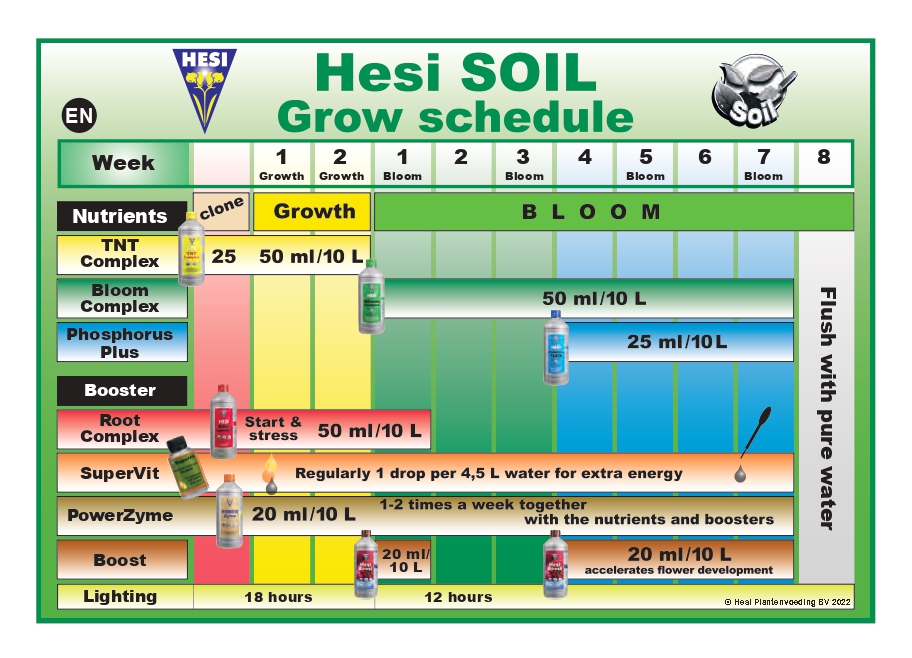
For soil cultivation, the Hesi program is mainly based on Hesi TNT Complex during vegetative growth and Hesi Bloom Complex during flowering. In the later flowering stage, the manufacturer also includes Hesi Phosphorus Plus.
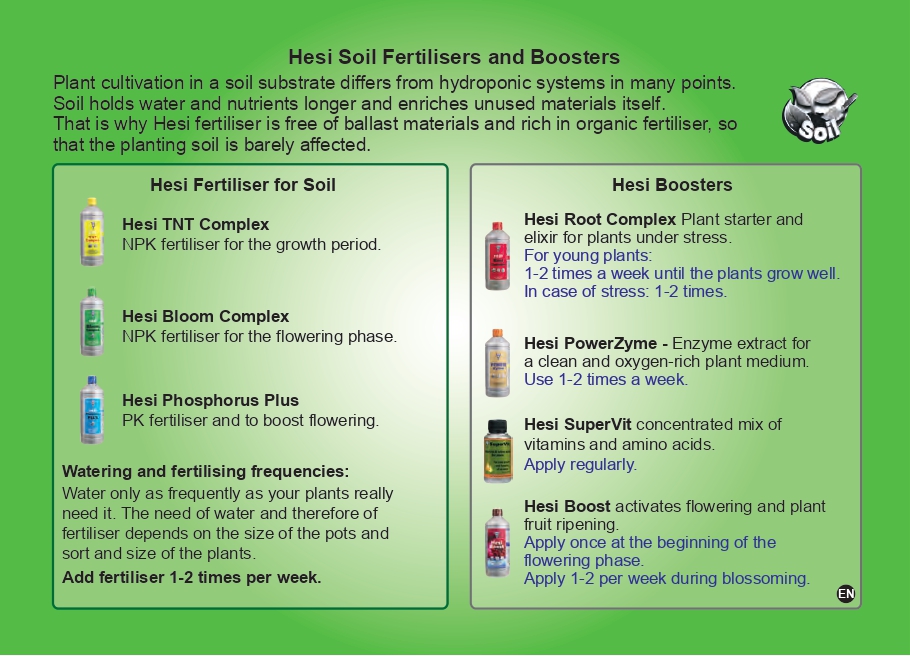
The program can be supplemented with products such as Root Complex, PowerZyme, SuperVit and Hesi Boost. The official Hesi feeding chart for soil is shown below.
Main Hesi nutrients for soil
Hesi TNT Complex
Hesi TNT Complex is mainly intended for the vegetative growth stage. It is used during periods of intensive leaf, stem and root development.
Hesi Bloom Complex
Bloom Complex is the main Hesi flowering nutrient for soil-grown plants. The standard manufacturer dosage is 50 ml per 10 litres of water. For young or sensitive plants, it can be sensible to begin with a lower concentration.
Hesi Phosphorus Plus
Phosphorus Plus supplies additional phosphorus and potassium during the later flowering stage. It is used together with Bloom Complex when the plant’s demand for P and K increases. The standard dosage is 25 ml per 10 litres of water.
Hesi Hydro – hydroponic feeding chart
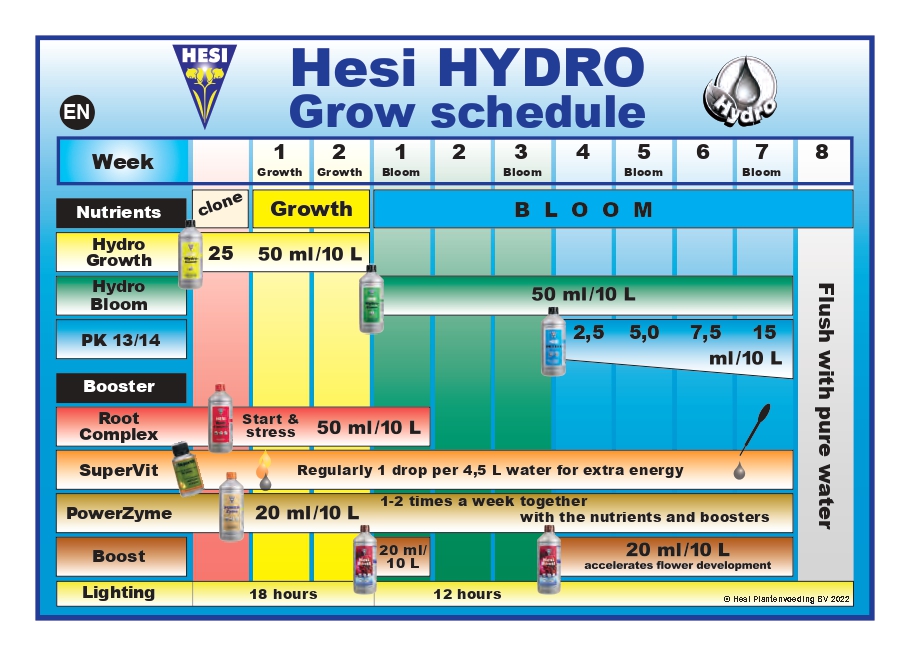
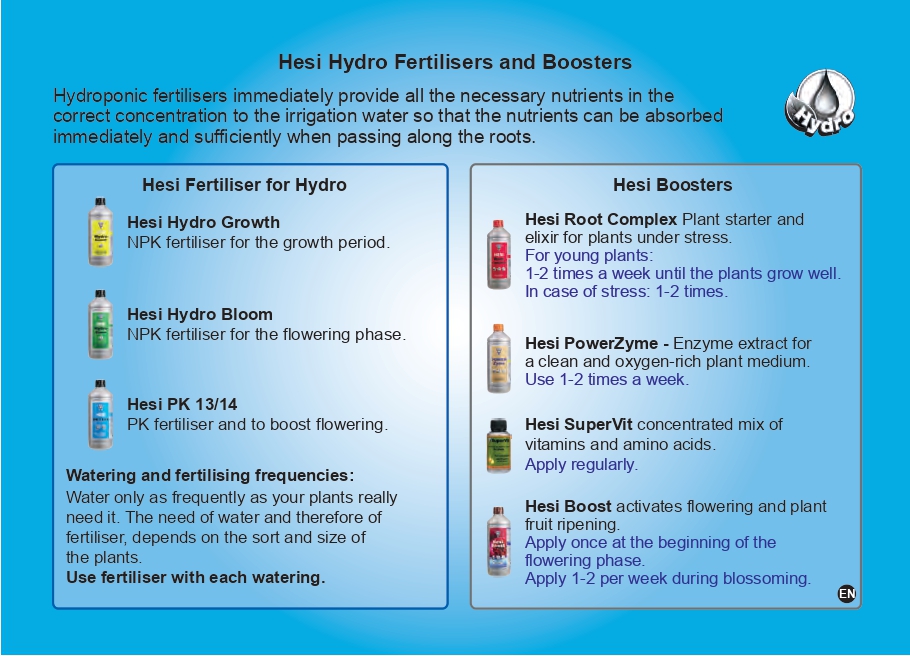
For hydroponic cultivation, Hesi offers separate base nutrients for vegetative growth and flowering. The feeding program can also include supplements such as Hesi PK 13/14.
In hydroponics, regular monitoring of EC and pH is especially important. The nutrient solution can change more quickly than in soil, so reservoir parameters should be checked regularly.
Hesi PK 13/14 – how to dose it
Hesi PK 13/14 is used during flowering to gradually increase the amount of phosphorus and potassium available in the nutrient solution. The dosage is normally increased step by step during the second half of flowering and is approximately 2.5–15 ml per 10 litres of water, depending on the stage.
It is not advisable to start with the maximum dose. Excessive PK levels can interfere with the uptake of other nutrients.
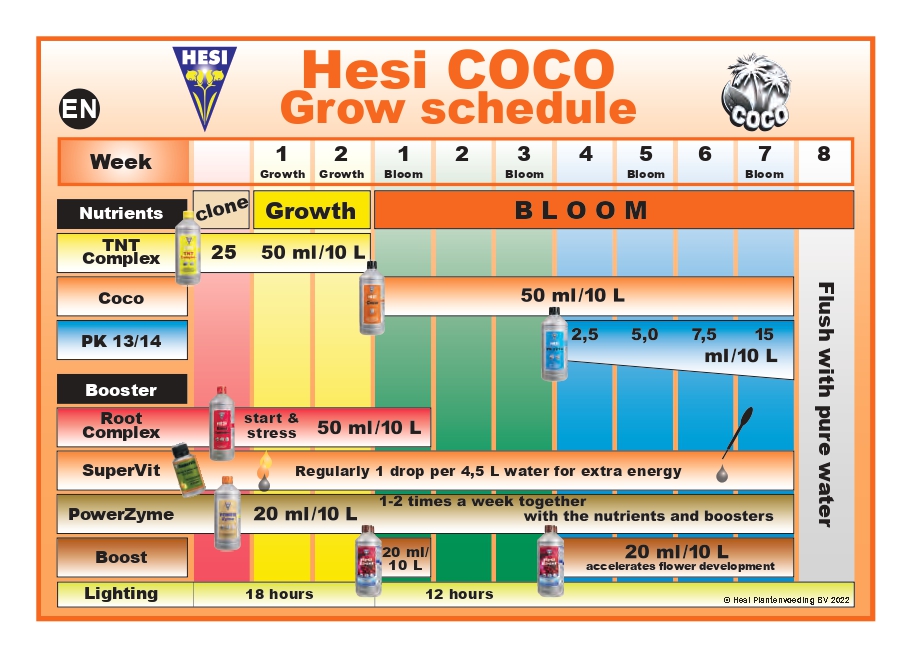
Hesi Coco – feeding chart for coco coir
Hesi has developed a separate feeding program for coco substrates. The main nutrient is Hesi Coco, while the official schedule may also include TNT Complex during vegetative growth. PK 13/14 can be added later in flowering.
Coco behaves differently from traditional soil, so it is especially important to monitor the EC of both the nutrient solution and the runoff.
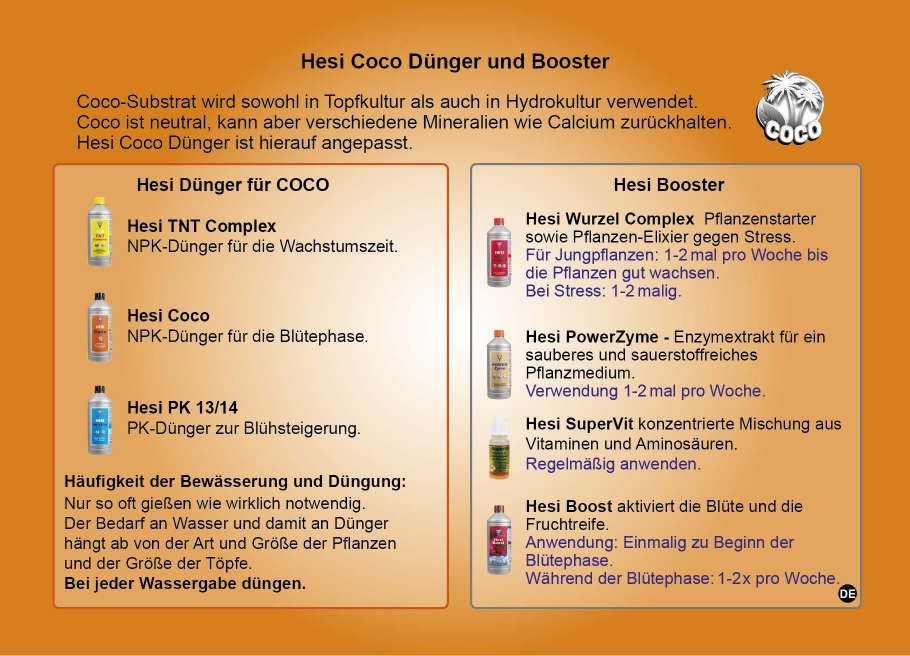
Hesi supplements – Root Complex, PowerZyme, SuperVit and Boost
In addition to its base nutrients, Hesi offers several supplements that are included in its official feeding schedules.
- Root Complex – supports root development, especially at the beginning of cultivation and after periods of stress.
- PowerZyme – an enzyme product used as part of the feeding program.
- SuperVit – a concentrated vitamin supplement used in very small quantities.
- Hesi Boost – a supplement used during flowering.
- PK 13/14 – an additional source of phosphorus and potassium mainly used in hydroponics and coco.
Should you always use the full Hesi dosage?
Not necessarily. The manufacturer’s chart is a good starting point, but nutrient demand can vary. Smaller plants, recently transplanted plants and plants growing in heavily pre-fertilized soil may require a weaker nutrient solution.
A safe approach is to begin with a lower concentration and observe the plant’s response. If the plant develops well, the dosage can be increased gradually.
FAQ – Hesi dosage
How often should Hesi nutrients be used?
The frequency depends on the product and the growing medium. Nutrients should be applied according to the relevant Soil, Coco or Hydro feeding schedule and adjusted to the plant’s condition and watering frequency.
How much Hesi Bloom Complex per 10 litres of water?
The standard dosage is 50 ml of Bloom Complex per 10 litres of water. For young or sensitive plants, starting with a lower dose may be preferable.
How much Hesi Phosphorus Plus per 10 litres?
The standard dosage is 25 ml per 10 litres of water. It is used together with Bloom Complex during the later flowering stage.
How should Hesi PK 13/14 be dosed?
PK 13/14 is introduced gradually during the second half of flowering. The dosage is approximately 2.5–15 ml per 10 litres of water, depending on the flowering stage.
Is Hesi suitable for soil?
Yes. Hesi has a dedicated Soil program. TNT Complex is used during vegetative growth, while Bloom Complex and later Phosphorus Plus are used during flowering.
Is Hesi suitable for coco?
Yes. Hesi provides a dedicated Coco feeding schedule for coco substrates. The Coco chart should be used instead of the Soil chart.
Is Hesi suitable for hydroponics?
Yes. Hesi offers a separate Hydro program with nutrients designed for vegetative growth and flowering, as well as supplements such as PK 13/14.
Can all Hesi nutrients be mixed together?
Not automatically. Individual nutrients and supplements are designed for different stages of plant development. It is best to follow the relevant Soil, Coco or Hydro feeding chart.
Hesi dosage – summary
The correct Hesi feeding chart should always match the growing medium: soil, coco or hydroponics. The Soil program includes products such as TNT Complex, Bloom Complex and Phosphorus Plus, while Hesi offers separate feeding schedules for Coco and Hydro.
The best results usually come from using the feeding chart as a reference while observing the plant’s response. In coco and hydroponic systems, regular monitoring of pH and EC is also recommended.